INVESTOR MORTGAGE GUIDE
How Does a DSCR Loan Work with a 1031 Exchange for Investment Properties: A Realtor's Guide
Your investor client just closed on the sale of a $1.2 million rental property, realizing $500,000 in taxable capital gains. The 45-day identification clock is ticking rapidly, and your buyer needs to secure a $700,000 replacement property to fully satisfy IRS debt-replacement requirements and avoid paying a massive tax bill. However, when your client approaches a traditional mortgage lender, they encounter an immediate roadblock: personal tax returns showing heavy paper write-offs, complex W-2 income verification hurdles, and a standard 60-day underwriting process that threatens to obliterate their 180-day exchange deadline. As a real estate agent, how do you keep this high-stakes transaction alive?
The answer lies in understanding how a DSCR loan works with a 1031 exchange for investment properties. Debt Service Coverage Ratio (DSCR) loans evaluate loan eligibility based strictly on the property's gross rental income rather than the borrower's personal tax returns or debt-to-income (DTI) ratios. When combined with a 1031 tax-deferred exchange, DSCR financing provides the speed, flexibility, and debt-matching capability realtors need to help investor clients successfully acquire replacement properties before statutory deadlines expire. In this comprehensive guide, you will learn the exact mechanics, underwriting criteria, common pitfalls, and step-by-step strategies required to guide your investor clients through DSCR-financed 1031 exchange transactions.
IN THIS GUIDE
Pairing property-income financing with exchange deadlines
How DSCR works
Rent divided by PITIA, what lenders require, and how it differs from conventional loans.
Fit the timeline
Pre-qualify before Day 45 and keep underwriting inside the 180-day window.
Avoid the mistakes
Late applications, appraisal rent haircuts, and prepayment penalties.
What Is a DSCR Loan and Why Realtors Need to Understand It
As a real estate professional working with active investors, your ability to navigate non-conventional financing options directly impacts your deal flow and client retention. Traditional residential mortgages rely heavily on personal income verification, pay stubs, and tax return audits. For self-employed real estate investors, real estate syndicators, or high-net-worth buyers who maximize tax deductions, conventional underwriting often presents an unnecessary barrier. A DSCR loan eliminates personal income hurdles by focusing entirely on the subject property's financial performance.
Understanding Debt Service Coverage Ratio (DSCR)
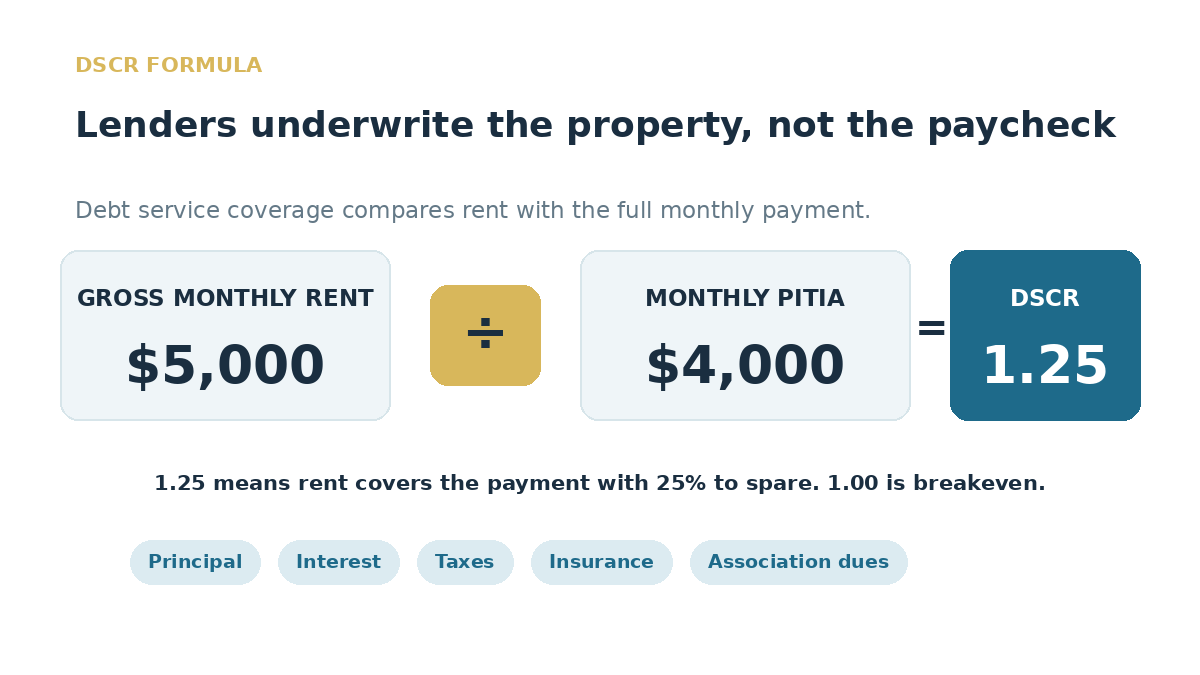
At its core, Debt Service Coverage Ratio (DSCR) is a simple financial formula used by commercial and investor-focused lenders to measure a rental property's ability to cover its monthly mortgage obligations. Lenders calculate DSCR by dividing the property's Net Operating Income (NOI) or gross monthly rental income by its total monthly Principal, Interest, Taxes, Insurance, and Association dues (PITIA).
DSCR = Gross Monthly Rental Income ÷ Monthly Debt Service (PITIA)
For example, if a single-family rental property or small multifamily building generates $5,000 in gross monthly rent, and the total monthly PITIA mortgage payment is $4,000, the DSCR calculation is:
DSCR = $5,000 ÷ $4,000 = 1.25
A DSCR ratio of 1.25 signifies that the property generates 25% more cash flow than required to service its monthly debt obligation. Lenders view a ratio of 1.0 as the breakeven threshold—meaning property rent exactly equals mortgage debt payments. Ratios below 1.0 indicate negative cash flow, while ratios above 1.0 demonstrate positive cash flow. Because DSCR lenders underwrite the property rather than the individual borrower, they do not request W-2s, tax returns, or personal income statements.
Why Investors Choose DSCR Loans After a 1031 Exchange
When real estate investors execute a 1031 exchange under Internal Revenue Code Section 1031, they defer federal capital gains taxes, state taxes, and depreciation recapture by reinvesting all net sale proceeds into "like-kind" replacement property. However, the IRS imposes two fundamental rules to achieve 100% tax deferral:
- Reinvest All Net Equity: The investor must reinvest 100% of the net cash proceeds generated from the relinquished property sale.
- Replace Equal or Greater Debt: The investor must purchase replacement property of equal or greater total value, which requires replacing or exceeding the mortgage debt paid off at the relinquished property closing.
If an investor sells a relinquished property for $1,000,000 with a $400,000 mortgage payoff and $600,000 in net cash equity, they must buy at least $1,000,000 worth of replacement property and secure at least $400,000 in new financing (or inject additional personal cash).
This is where DSCR loans become indispensable. Conventional lenders often hesitate to approve investors purchasing multiple properties simultaneously or buyers who recently shifted from W-2 employment to full-time real estate investing. By choosing a DSCR loan, your investor client can secure the necessary replacement mortgage without personal DTI constraints. Working alongside an experienced advisory platform like x1031 Exchange allows realtors to align mortgage underwriting seamlessly with qualified intermediary (QI) escrow instructions.
The Mechanics: How a DSCR Loan Works Within a 1031 Exchange Transaction
Executing a DSCR-financed 1031 exchange requires strict synchronization between the mortgage lender, the real estate agent, the title company, and the Qualified Intermediary. Because 1031 exchange rules prohibit the taxpayer from taking "constructive receipt" of sale proceeds, all exchange cash must flow directly from the relinquished closing through the QI's escrow account into the replacement property closing.
The 1031 Exchange Timeline and DSCR Loan Approval Windows
Section 1031 establishes two non-negotiable statutory timelines that begin the moment the relinquished property transaction closes:
- The 45-Day Identification Window: Within exactly 45 calendar days of closing the relinquished property sale, the investor must formally identify potential replacement properties in a written document delivered to the Qualified Intermediary.
- The 180-Day Exchange Completion Window: The investor must acquire the replacement property and complete the transaction within 180 calendar days of the relinquished closing (or the tax return due date, whichever comes first).
Conventional mortgage underwriting routinely stretches past 45 to 60 days, introducing immense risk into a 1031 exchange. If a conventional lender encounters appraisal delays, title issues, or personal underwriting inquiries during week 5, your client may miss their 45-day identification target or fail to close within 180 days.
In contrast, DSCR lenders streamline property underwriting. Because loan approval relies primarily on an appraisal, an unrated lease agreement, or an Appraisal Form 1007/1025 Market Rent Schedule, DSCR loans frequently close within 14 to 21 business days. As a realtor, recommending a DSCR lender gives your investor client the confidence to lock in replacement properties early in the 45-day window without fearing loan denial late in the process.
Key Differences Between DSCR Loans and Conventional Financing
To effectively counsel investor clients, realtors must understand how DSCR loans differ from standard conventional mortgages across key structural dimensions:
| Loan Attribute | DSCR Financing | Conventional Investor Financing |
|---|---|---|
| Primary Qualification | Property Net Operating Income / Rent | Personal W-2, Tax Returns, & DTI |
| Tax Returns Required | None (No W-2s, No 1040s) | 2 Years Full Personal & Business Returns |
| Underwriting Speed | 14 to 21 Business Days | 45 to 60 Calendar Days |
| Entity Title (LLC/Corp) | Allowed & Preferred | Restricted (Must Title in Personal Name) |
| Max Financed Properties | Unlimited | Capped at 10 Fannie/Freddie Loans |
| Prepayment Penalties | Common (e.g., 3-2-1 or 5-year step-down) | Rarely Applied |
Understanding these distinctions enables realtors to position DSCR loans as strategic instruments for portfolio expansion rather than mere emergency backup financing.
DSCR Loan Requirements for 1031 Exchange Replacement Properties
While DSCR loans bypass personal income checks, lenders enforce strict property-level underwriting criteria. Realtors must evaluate candidate replacement properties against these standards before submitting formal 45-day identification notices to the Qualified Intermediary.
Minimum DSCR Ratios and How They Impact Deal Viability
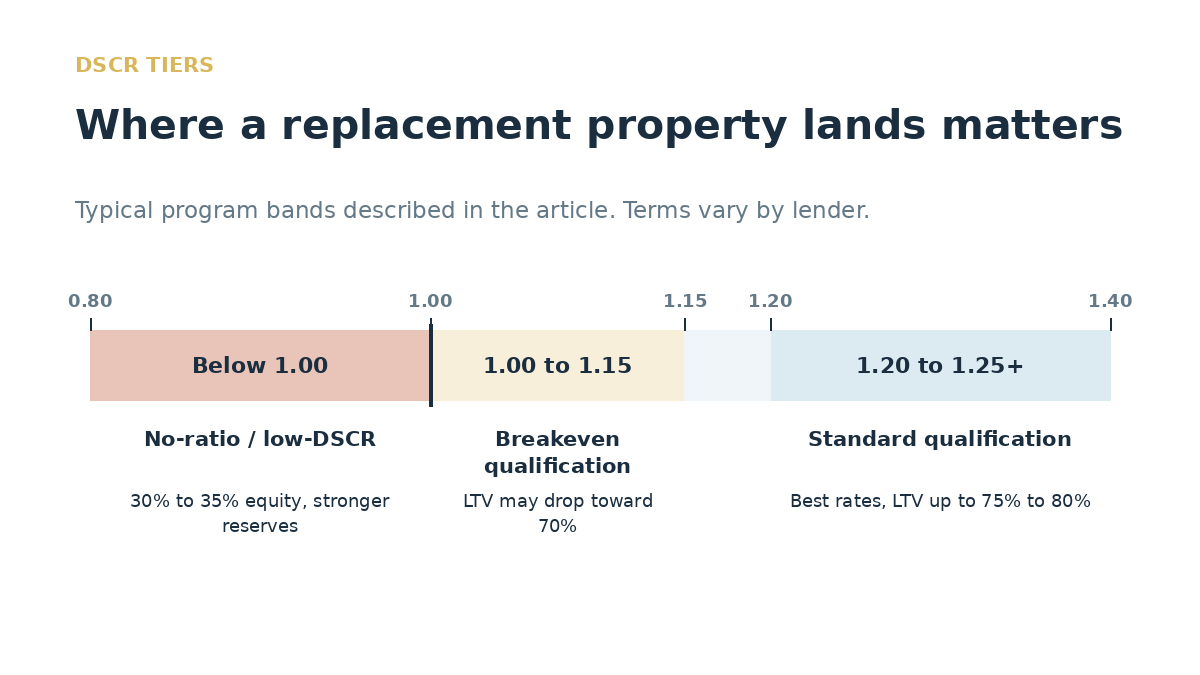
Most institutional DSCR lenders require a minimum coverage ratio ranging from 1.00 to 1.25.
- Standard Qualification (1.20 - 1.25 DSCR): Properties generating 20% to 25% surplus cash flow qualify for optimal interest rates, higher Loan-to-Value (LTV) limits (typically up to 75% or 80%), and reduced reserve requirements.
- Breakeven Qualification (1.00 - 1.15 DSCR): Properties where monthly rent barely covers monthly debt service remain financeable, though lenders may adjust LTV limits down to 70% or slightly increase the interest rate.
- No-Ratio / Low-DSCR Programs (< 1.00 DSCR): Select specialized DSCR lenders offer "no-ratio" loans for vacant properties or value-add acquisitions where gross rents fall below total debt service. These programs require higher cash down payments (30% to 35% equity) and stronger borrower liquid credit reserves.
Realtors evaluating replacement inventory should work with lenders to model projected PITIA payments against realistic appraisal market rents before submitting purchase offers.
What Happens When a Property Falls Below DSCR Minimums
If an appraisal Form 1007 rent schedule reveals that market rent is lower than anticipated, the property's DSCR ratio may drop below the lender's approval threshold. In a 1031 exchange, this creates a potential deal crisis if not managed proactively. When a property fails to meet minimum DSCR targets, lenders typically present three options:
- Inject Additional Equity (Down Payment Buy-Down): The buyer increases their down payment using exchange cash equity, reducing the loan amount and lowering the monthly debt service until the DSCR meets the required 1.20 or 1.25 threshold.
- Interest Rate Buy-Down: The investor pays discount points at closing to permanently lower the interest rate, reducing the monthly principal and interest payment to restore cash flow coverage.
- Short-Term Lease Adjustments: If the property is currently under-rented relative to market rates, executing a new lease agreement with a verified tenant prior to loan closing can raise gross income to satisfy underwriting requirements.
Common Mistakes Realtors Make When Combining DSCR Loans with 1031 Exchanges
Combining non-QM debt service loans with IRS tax-deferral regulations requires precision. Real estate agents who lack experience in this niche frequently commit errors that jeopardize client tax deferral or trigger unexpected tax liabilities.
Timing Errors That Kill Deals
The most catastrophic error in a 1031 exchange is failing to align loan approval with the statutory 45-day identification and 180-day closing deadlines. A common realtor mistake is delaying the loan application until after the 45-day identification window closes. If an unvetted property is identified and the DSCR lender later rejects the deal during underwriting, the investor cannot add new properties to their identification list after day 45. Consequently, the exchange fails, and the investor faces full tax recognition.
To avoid this, realtors must ensure the DSCR lender completes a preliminary property review and rent analysis before day 45.
Underestimating Property Income Requirements
Realtors often assume that existing lease amounts automatically satisfy DSCR underwriting. However, DSCR lenders rely on the lower of actual in-place lease rent or the appraiser's Form 1007 fair market rent opinion. If an investor contracts to buy a property rented at $3,500 per month, but the appraiser determines fair market rent is only $3,000, the lender will underwrite the loan using $3,000. This unexpected drop can reduce the maximum approved loan amount, creating a debt shortfall that triggers taxable "mortgage boot" unless offset with extra cash.
Failing to Advise Clients on Exit Strategies
While DSCR loans offer rapid closing capabilities, they frequently carry prepayment penalties (such as a 3-year or 5-year step-down penalty structure like 3%, 2%, 1%). Realtors who fail to discuss loan exit strategies with clients may lock investors into high-interest debt structures without a clear path toward future refinancing or portfolio stabilization. Real estate professionals should collaborate with x1031 Exchange advisors to ensure the client's long-term hold period matches the selected loan terms.
How to Guide Your Investor Clients Through DSCR Financing in a 1031 Exchange
To position yourself as an indispensable real estate advisor, you must implement a structured workflow that integrates property sourcing, mortgage pre-qualification, and Qualified Intermediary coordination.
Step-by-Step Process for Realtors
- Pre-Listing Financial Discovery: Before listing the relinquished property, verify the client's current mortgage balance and estimated net proceeds to determine precise debt and equity replacement targets.
- Engage Qualified Intermediary Early: Establish the 1031 exchange account with a reputable Qualified Intermediary prior to closing the relinquished property sale.
- Pre-Qualify for DSCR Financing: Connect your client with a specialized DSCR mortgage lender during the pre-listing phase to establish target credit scores, liquid reserve requirements, and maximum LTV limits.
- Source Cash-Flowing Replacement Properties: Focus replacement property searches on assets meeting or exceeding a 1.20 DSCR based on current market rents.
- Execute Parallel Identifications: Utilize the 3-Property Rule or 200% Rule to identify primary and secondary replacement properties, ensuring all candidates are pre-screened for DSCR eligibility before day 45.
- Coordinate Title & Vesting: Ensure the replacement property purchase contract and DSCR loan documents match the exact tax entity (e.g., single-member LLC) that held title to the relinquished property.
Red Flags to Watch For During Underwriting
During loan processing, realtors should actively monitor for red flags that could disrupt closing schedules:
- Short-Term Rental (Airbnb/VRBO) Income Discrepancies: If your client is purchasing a short-term rental, verify whether the DSCR lender accepts AirDNA projections or requires 12 months of historical property management statements.
- Uncooperative Existing Tenants: Lenders require lease agreements and estoppel certificates. Delayed tenant documentation can stall underwriting.
- Deferred Maintenance Issues: Major structural, roof, or HVAC deferred maintenance flagged in the appraisal can stall loan funding until escrow holdbacks or seller repairs are negotiated.
Why DSCR Loans Are Often Smarter Than Conventional Financing for 1031 Exchanges
For real estate investors acquiring rental properties, DSCR loans offer strategic advantages that extend far beyond bypassing personal tax return reviews.
Flexibility in Borrower Qualification
Because DSCR financing evaluates property performance, investors can title replacement properties directly inside newly created Limited Liability Companies (LLCs) or special purpose entities without impacting loan approval. Conventional Fannie Mae guidelines mandate that residential loans be closed in the borrower's personal name, creating legal friction for investors seeking asset protection. DSCR lenders actively encourage LLC vesting, perfectly aligning with investor wealth protection goals.
Faster Closings and Compliance with Exchange Deadlines
In competitive real estate markets, seller selection often hinges on closing speed. An investor backed by a DSCR loan can present purchase offers with 21-day closing timelines and zero personal financial contingencies. This execution speed gives your clients a decisive competitive edge over buyers relying on 60-day conventional approval processes, ensuring strict compliance with the 180-day IRS exchange window.
Building a Multi-Property Portfolio Through Repeat Exchanges
Finally, DSCR loans empower investors to scale portfolios without hitting conventional lending limits. While Fannie Mae caps individual borrowers at 10 financed properties, DSCR lenders impose no portfolio limits. By pairing DSCR financing with repeat 1031 exchanges, your investor clients can continuously compound tax-deferred equity across dozens of income-producing residential and commercial properties. Partnering with advisory resources like x1031 Exchange helps realtors build enduring, repeatable business relationships with active real estate investors.
Common Questions
Frequently Asked Questions
A Debt Service Coverage Ratio (DSCR) loan is a business-purpose mortgage that qualifies real estate borrowers based entirely on the gross rental income generated by the subject property, rather than personal tax returns, W-2 statements, or debt-to-income ratios. Lenders calculate DSCR by dividing monthly rental revenue by total monthly debt service (principal, interest, taxes, insurance, and HOA dues). Real estate investors frequently utilize DSCR financing following a 1031 exchange because it allows them to meet IRS debt-replacement obligations rapidly without undergoing length personal underwriting audits. This streamlined execution is vital for self-employed buyers, full-time property investors, and buyers navigating strict 180-day exchange windows.
Yes, realtors can educate investor clients about DSCR loans as a highly effective financing strategy for acquiring replacement properties in a 1031 exchange. Highlighting DSCR options demonstrates advanced market expertise, helps buyers overcome traditional debt-to-income limits, and avoids slow conventional underwriting processes that endanger exchange deadlines. For instance, if your investor client is acquiring a $750,000 rental property to complete an exchange, introducing a DSCR lender can accelerate loan approval significantly. However, realtors must maintain strict professional boundaries by offering educational insights rather than formal lending, tax, or legal counsel. Agents should always recommend that investor clients consult with their Qualified Intermediary, tax advisor, and specialized mortgage lender to ensure complete regulatory compliance and transaction success.
Most institutional DSCR lenders mandate a minimum coverage ratio of 1.00 to 1.25 when financing a 1031 exchange replacement property. For example, a 1.20 DSCR signifies that the property's gross monthly rental revenue exceeds total monthly mortgage principal, interest, taxes, insurance, and HOA dues by 20%. Ratios of 1.20 or higher unlock maximum loan-to-value allowances (up to 80%) and the most competitive interest rates. Properties with ratios between 1.00 and 1.15 remain eligible but may require lower LTV ratios or higher cash reserves. Specialized low-DSCR or no-ratio loan programs exist for value-add assets but require larger down payments.
A DSCR loan is frequently superior to a conventional mortgage during a 1031 exchange when underwriting speed, corporate entity structuring, or borrower qualification is critical. Conventional investor loans mandate exhaustive personal tax return audits, cap borrowers at 10 financed properties, and typically take 45 to 60 days to close, risking strict IRS 180-day completion windows. Conversely, DSCR financing closes in 14 to 21 days, permits direct vesting inside single-member LLCs, and imposes no portfolio property caps. While conventional loans may offer slightly lower interest rates for qualifying buyers, DSCR loans deliver unmatched execution speed, flexibility, and scalability for active real estate investor portfolios.
If an appraiser's Form 1007 rent schedule indicates that a replacement property generates insufficient income to meet the lender's minimum DSCR ratio, the mortgage application cannot be approved under standard terms. To resolve this issue, the investor can contribute additional cash equity from exchange funds to reduce the total loan amount, thereby lowering monthly debt payments until the DSCR achieves approval levels. For example, on a $600,000 purchase, injecting an additional $30,000 down payment lowers monthly debt service enough to achieve a passing 1.20 ratio. Alternatively, the buyer can pay discount points to permanently buy down the None interest rate or negotiate a new lease agreement with existing tenants prior to closing to increase verified monthly revenue and satisfy underwriting guidelines.
The single biggest mistake realtors make is failing to pre-qualify the replacement property for DSCR financing before the statutory 45-day identification period expires. If a lender rejects an unvetted property after day 45, the investor cannot modify their identification form, causing the entire 1031 exchange to fail and triggering massive capital gains taxes. Additional common errors include underestimating appraiser market rent opinions on Form 1007, neglecting loan prepayment penalty structures during exit planning, failing to align exact tax entity vesting names between relinquished and replacement property titles, and failing to coordinate escrow instructions between the mortgage lender and Qualified Intermediary.
Conclusion
Mastering how a DSCR loan works with a 1031 exchange for investment properties elevates your real estate practice from standard transactional representation to high-value advisory service. By eliminating personal debt-to-income hurdles, facilitating rapid 21-day closings, and supporting LLC title vesting, DSCR financing empowers your investor clients to meet strict IRS identification and exchange completion deadlines with complete confidence. When you proactively guide clients through debt replacement requirements, property cash flow modeling, and early Qualified Intermediary coordination, you secure their tax deferral goals, build lasting investor trust, and create repeatable transaction opportunities across growing rental property portfolios.
Take the Next Step with x1031 Exchange
If you are ready to deepen your expertise on 1031 exchanges, DSCR financing strategies, and debt replacement mechanics, visit x1031.com today. Our advisory platform provides detailed deal-structuring tools, timeline tracking checklists, and professional Qualified Intermediary consultation resources tailored specifically to help real estate agents and active property investors execute seamless tax-deferred exchanges.
Start Your Exchange →Disclaimer
Educational information only. x1031 Exchange is an advisory platform and does not provide legal, tax, or lending advice. Real estate professionals and investors should consult with their qualified intermediary, CPA, tax attorney, and mortgage lender regarding their specific transaction.
Sources and official references
- Like-Kind Exchanges: Real Estate Tax Tips, Internal Revenue Service
- 26 U.S. Code § 1031, Exchange of Real Property Held for Productive Use or Investment, Cornell LII
- 26 CFR § 1.1031(k)-1, Treatment of Deferred Exchanges, Cornell LII
- General Rental Income Information (B3-3.1-08), Fannie Mae Selling Guide
- DSCR Loans, Bond Street Mortgage