INVESTOR MORTGAGE GUIDE
Can You Refinance a Property During a 1031 Exchange Without Breaking the Rules?
Refinancing a rental property mid-1031 exchange feels like navigating a legal and tax minefield—one wrong move or poorly timed cash distribution could trigger tens of thousands of dollars in unexpected capital gains taxes. Yet, despite the widespread anxiety surrounding debt restructuring, the Internal Revenue Service (IRS) does not prohibit refinancing in connection with a tax-deferred exchange under Treasury Regulation § 1.1031(k)-1. Investors frequently utilize debt refinancing to extract equity, lower debt service costs, or balance the capital stack when acquiring replacement real estate. The primary challenge lies in structuring the transaction so that the refinance proceeds are not recharacterized by tax authorities as taxable "boot" or an improper pre-exchange cash extraction. Understanding how the IRS views debt refinancing before, during, and after a 1031 exchange allows commercial and residential investors to preserve their tax deferral while maximizing portfolio liquidity.
IN THIS GUIDE
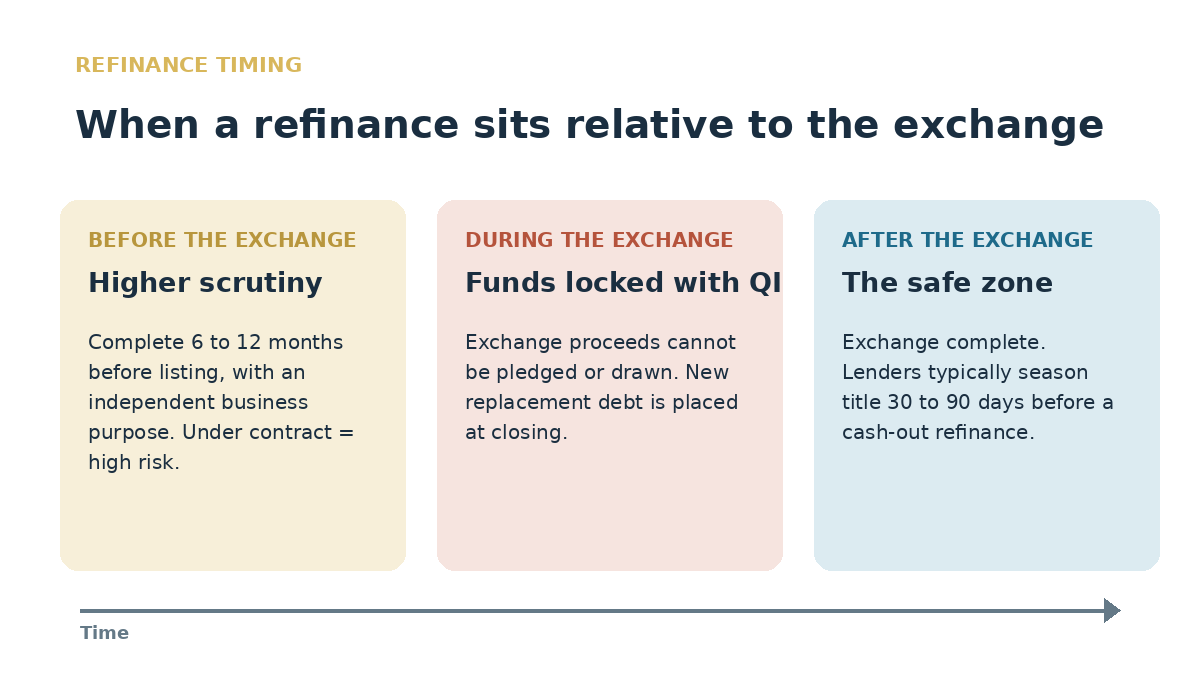
Where a refinance can sit around a 1031 exchange
Before the exchange
Pre-sale cash-out refinances, boot risk, and why timing and business purpose matter.
During the exchange
Exchange funds stay with the QI; new replacement debt is placed at closing.
After the exchange
Why a post-closing refinance is the lower-risk path, and typical seasoning periods.
The Core Rule: What the IRS Actually Allows During a 1031 Exchange
The fundamental objective of a Section 1031 exchange is to defer capital gains tax and depreciation recapture by swapping one investment property for another of equal or greater value. To achieve full tax deferral, an investor must meet two core balance conditions: reinvesting 100% of the net equity realized from the sale of the relinquished property and acquiring replacement debt equal to or exceeding the mortgage balance paid off at closing. When refinancing enters the picture, IRS scrutiny intensifies because pulling cash out of a transaction can look like an advance realization of capital gain.
Under established tax court precedents and IRS revenue rulings, loan proceeds obtained through a bona fide, arm's-length refinancing transaction are generally treated as non-taxable debt rather than taxable income or capital gain. Borrowed money carries an obligation of repayment; therefore, it does not constitute a net economic gain to the taxpayer. However, when refinancing occurs in close proximity to a 1031 exchange, the IRS examines the step-transaction doctrine—an auditing principle that collapses multiple related steps into a single integrated transaction to evaluate its true economic substance.
The 45-Day Identification Period and Refinancing
The 45-day identification period represents one of the most inflexible statutory windows in federal tax law. Beginning the day the relinquished property deed transfers to the buyer, the taxpayer has exactly 45 calendar days to identify potential replacement properties in writing to the Qualified Intermediary (QI). Attempting to execute a refinance on either the relinquished property or a prospective replacement property within this 45-day window requires extreme legal and financial coordination.
During these 45 days, the exchange funds must remain strictly held in a qualified escrow or trust account under the control of the QI. The exchangor cannot receive, control, or pledge those funds as collateral for a new mortgage. If an investor attempts to obtain financing on a replacement property during the 45-day window, the loan must be underwritten and structured as independent replacement property debt rather than a cash draw against exchange funds. Any loan proceeds disbursed directly to the investor prior to the final closing of the replacement property risk violating the constructive receipt rules, effectively invalidating the entire tax-deferred exchange.
The 180-Day Exchange Period and Refinancing
The 180-day exchange period dictates the total timeframe within which the taxpayer must acquire and close title on the identified replacement property. Like the identification deadline, the 180-day rule is absolute, offering no extensions for loan underwriting delays, appraisal bottlenecks, or title defects. When refinancing is integrated into the purchase of the replacement property, synchronization between the lender, the title company, and the Qualified Intermediary is paramount.
Refinancing an existing portfolio property or securing new leverage on the replacement property during the 180-day window is fully allowable under IRS guidelines, provided the transaction mechanics are respected. New mortgage debt placed on the replacement property at the time of purchase is reflected on the settlement statement as part of the total acquisition financing. As long as the combination of exchange equity from the QI and new mortgage debt equals or exceeds the total purchase requirement, the investor satisfies both the equity reinvestment and debt replacement rules without generating taxable mortgage boot.
Refinancing Your Relinquished Property Before the Exchange (The Smart Move)
Extracting equity from an investment property prior to initiating a 1031 exchange is a strategy favored by sophisticated real estate investors seeking cash liquidity without immediate tax friction. Because refinancing a property is a non-taxable event, receiving cash proceeds from a loan cash-out refinancing does not generate capital gains tax at the time of disbursement. However, executing a cash-out refinance on a relinquished property shortly before selling it requires careful adherence to IRS guidelines.
If an investor refinances a property and immediately enters into a contract to sell that same property through a 1031 exchange, tax auditors may invoke the step-transaction doctrine. The IRS may argue that the refinance and the sale were an integrated plan designed solely to pull tax-free cash out of the real estate prior to the exchange, effectively converting taxable sale proceeds into non-taxable loan proceeds.
Why Pre-Exchange Refinancing Makes Sense
Pre-exchange refinancing allows real estate owners to access accumulated equity while maintaining ownership of the underlying real estate. Investors frequently utilize pre-exchange refinancing to deploy capital into separate business ventures, pay down high-interest liabilities, or fund initial deposits on prospective replacement properties before the relinquished property closes.
When executed properly, a pre-exchange refinance increases the outstanding mortgage liability on the relinquished property. Consequently, when the property sells, a larger portion of the gross sale proceeds is used to pay off the new mortgage at the closing table, leaving a smaller net equity balance to transfer to the Qualified Intermediary. Because the investor must replace the new higher mortgage amount on the replacement property, the investor effectively transfers the leverage to the new asset while retaining the tax-free cash proceeds extracted during the refinance.
Cash-Out Refinance and Boot Implications
The primary risk associated with pre-exchange cash-out refinancing is the creation of taxable "boot." In 1031 exchange terminology, boot refers to any non-like-kind property, cash, or net debt reduction received by the taxpayer in an exchange. Boot is fully taxable up to the amount of gain realized on the transaction.
If the IRS determines that a pre-exchange refinance lacked an independent business purpose and was executed in anticipation of the sale, the loan proceeds will be reclassified as cash boot. For example, if an investor refinances $200,000 out of a commercial building thirty days before closing the sale, and the IRS collapses the two events, the $200,000 will be treated as cash proceeds received from the sale rather than loan debt. This reclassification immediately triggers capital gains taxes and depreciation recapture on the $200,000, defeating the purpose of the tax deferral.
Timing the Relinquished Property Refinance
To protect a pre-exchange refinance from IRS challenge, investors must establish two critical elements: temporal separation and an independent business purpose. Real estate attorneys and tax professionals generally recommend completing any cash-out refinance well in advance of listing or marketing the property for sale.
While the Internal Revenue Code does not state a statutory "safe harbor" timeframe for pre-exchange refinancing, an interval of six to twelve months between the refinance and the sale contract significantly reduces audit risk. Furthermore, maintaining clear documentation of an independent business purpose—such as using the loan proceeds to make capital improvements on another rental property, fund business operations, or purchase equipment—provides strong evidence that the refinancing was an independent financial decision rather than a tax-avoidance scheme tied directly to the 1031 exchange.
Refinancing Your Replacement Property After Closing (The Safe Zone)
For investors who prefer to eliminate tax risk altogether, refinancing the replacement property after the 1031 exchange has successfully closed is widely regarded by tax practitioners as the safest strategy. Once the exchange is complete, title to the replacement property has transferred, and the Qualified Intermediary has disbursed all funds, the statutory requirements of Section 1031 are satisfied.
In Revenue Ruling 82-96 and subsequent tax court opinions, the IRS confirmed that post-exchange refinancing does not impact the tax-deferred status of a completed exchange. Because the taxpayer has fully reinvested the sale proceeds and satisfied the debt replacement rules at the closing of the replacement property, subsequent debt placement is treated as an independent financial event.
Why Post-Exchange Refinancing Is Lower Risk
Post-exchange refinancing carries significantly lower audit risk because the transaction occurs completely outside the closed exchange window. The taxpayer has already fulfilled the statutory duty of acquiring like-kind replacement property equal to or greater in value and debt than the relinquished property.
When an investor completes a cash-out refinance on a replacement property thirty, sixty, or ninety days after closing, the loan proceeds represent newly created debt secured by the replacement asset. Because the obligation to repay the lender rests entirely on the owner and the replacement property, the cash disbursed at closing is non-taxable loan proceeds. The IRS cannot argue that the cash represents un-reinvested sale proceeds from the relinquished property, because those proceeds were 100% committed to the original purchase.
How Soon Can You Refinance After Your 1031 Exchange Closes?
A common question among real estate investors is how long they must wait after closing on a replacement property before executing a cash-out refinance. Technically, because Section 1031 contains no explicit statutory waiting period for post-exchange refinancing, an investor could apply for refinancing immediately after taking title.
However, mortgage underwriting conventions and practical prudence dictate a short seasoning period. Most commercial lenders, portfolio institutions, and agency underwriters require title seasoning of at least 30 to 90 days before underwriting a cash-out refinance based on updated property appraisals. Waiting until the exchange is finalized and the closing settlement statement is recorded ensures that the paper trail clearly establishes two distinct transactions: a fully compliant 1031 purchase followed by an independent property refinancing.
Loan Products That Work Best for Replacement Properties
Choosing the right mortgage product for a replacement property depends on the investor's long-term hold strategy, cash flow requirements, and execution speed. Because replacement properties must meet strict debt replacement rules, matching the loan structure to property operations is critical.
Debt Service Coverage Ratio (DSCR) loans have emerged as one of the most popular loan products for 1031 exchange replacement properties. Unlike traditional conventional loans that require extensive personal income verification and tax returns, DSCR loans underwrite the asset based on the property's rental cash flow relative to its principal, interest, taxes, and insurance (PITI) obligations. Working with specialized platforms like x1031 Exchange allows investors to identify flexible portfolio lenders and DSCR loan products tailored specifically to match replacement property debt requirements without delaying tight exchange closings.
The Biggest Mistakes Investors Make When Combining Refinancing and 1031 Exchanges
Combining real estate debt refinancing with a 1031 exchange requires flawless execution. Because tax laws strictly govern exchange mechanics, minor missteps in timing, documentation, or fund handling can result in total exchange disqualification. Understanding the most frequent errors empowers investors to safeguard their tax deferral.
Waiting Too Long to Refinance the Relinquished Property
One of the most frequent errors investors make is initiating a cash-out refinance on the relinquished property after a buyer has already been secured or an purchase agreement has been executed. When a refinance takes place while the property is under contract or in escrow, IRS auditors can easily demonstrate that the refinancing was executed in contemplation of the sale.
Under the step-transaction doctrine, the IRS will merge the refinancing into the sale transaction, recharacterizing the cash proceeds as taxable boot received at closing. If equity extraction is necessary prior to a sale, the refinance must be completed well before marketing the asset, backed by a documented business rationale independent of the upcoming disposition.
Failing to Track Reinvestment Deadlines While Refinancing
Investors attempting to arrange replacement property debt during the active exchange period often underestimate the time required for commercial loan underwriting. Commercial mortgages, conventional bank loans, and agency debt often require 45 to 60 days for processing, third-party appraisals, environmental reports, and legal documentation.
If an investor relies on a lender who fails to perform before the expiration of the 180-day exchange period, the exchange fails, and the full capital gains tax liability becomes due immediately. Working with experienced financing partners such as x1031 Exchange helps ensure that replacement property loans, bridge financing, or DSCR mortgages are underwritten and cleared for closing well within statutory exchange deadlines.
Using Cash from a Refinance to Fund the Replacement Property
Another critical mistake is attempting to use cash proceeds extracted from a pre-exchange refinance to directly satisfy the equity reinvestment requirement on the replacement property. While this may seem like an efficient use of capital, it creates significant tax traps.
All net cash equity generated from the sale of the relinquished property must flow directly through the Qualified Intermediary to the replacement property closing. Attempting to substitute pre-exchange refinance cash for actual sale proceeds held by the QI can trigger constructive receipt issues or result in an improper calculation of net exchange value, leading to unintended tax exposure.
Mortgage Products and Lenders That Support 1031 Exchange Investors
Navigating debt placement during or around a 1031 exchange requires mortgage products designed specifically for investor speed, flexibility, and compliance. Standard conventional residential mortgages often lack the structural flexibility needed to accommodate tight exchange deadlines or complex entity structures.
Bridge Loans for Timing Flexibility
When exchange timing becomes constricted—such as when a replacement property seller demands a fast 15-day closing or when conventional financing stalls—short-term bridge loans offer an essential liquidity solution. Bridge financing provides rapid capital to acquire the replacement property, allowing the investor to complete the exchange within the 180-day window.
Once the replacement property is successfully acquired and the 1031 exchange is officially closed, the investor can seamlessly refinance the short-term bridge loan into long-term permanent debt, such as a 30-year fixed DSCR loan or commercial portfolio mortgage, completely free of exchange-related tax risk.
Portfolio Lenders vs. Conventional Lenders
Portfolio lenders—institutions that originate and retain mortgages on their own balance sheets rather than selling them into the secondary market—are exceptionally well-suited for 1031 exchange transactions. Portfolio underwriters have the authority to customize loan terms, accommodate specialized entity structures (such as single-member LLCs or Delaware Statutory Trusts), and approve post-exchange debt modifications without rigid secondary market guidelines.
Conventional lenders, by contrast, are bound by strict Fannie Mae and Freddie Mac underwriting rules that may impose rigid title seasoning requirements, personal debt-to-income limits, or restrictions on ownership entity transfers that complicate 1031 compliance.
How x1031 Exchange Can Help You Find the Right Financing
Structuring debt before, during, or after a 1031 exchange requires close alignment between your Qualified Intermediary, tax advisers, and mortgage professionals. x1031 Exchange serves as a specialized resource for real estate investors, offering access to tailored mortgage products, DSCR financing solutions, and bridge loans engineered specifically for tax-deferred exchanges. By aligning your financing strategy with proven exchange mechanics, x1031 Exchange helps you maximize portfolio leverage, preserve capital gains deferral, and acquire high-performing replacement properties with confidence.
Common Questions
Frequently Asked Questions
A Section 1031 exchange allows real estate investors to defer capital gains taxes and depreciation recapture when selling an investment property by reinvesting all proceeds into a like-kind replacement property. To achieve full tax deferral, the investor must reinvest 100% of the net equity and replace any outstanding mortgage debt. Refinancing fits into a 1031 exchange as a strategic tool to access capital, restructure debt, or meet replacement property financing requirements. Because loan proceeds are not considered taxable income by the IRS, refinancing allows investors to extract equity tax-free. However, when refinancing occurs shortly before or after an exchange, strict IRS rules regarding boot and the step-transaction doctrine must be followed to avoid triggering unexpected tax liabilities.
Investors can technically refinance a replacement property shortly after closing because Section 1031 contains no statutory waiting period for post-exchange refinancing. Once title transfers and the Qualified Intermediary completes the exchange, the tax-deferred transaction is finalized. Most tax attorneys and commercial lenders recommend waiting between 30 to 90 days after closing before executing a post-exchange cash-out refinance. This brief seasoning period allows the title and closing documents to settle cleanly, establishing two separate legal events: a compliant 1031 property acquisition followed by an independent refinancing transaction. Refinancing after closing carries significantly lower audit risk than pre-exchange refinancing because all exchange equity and debt requirements were fully satisfied during the initial purchase.
Investors refinance before a 1031 exchange primarily to extract accumulated cash equity tax-free without triggering an immediate sale event. This extracted cash can be deployed into other investment opportunities, business operations, or property capital improvements. While pre-exchange refinancing offers attractive liquidity, it must be executed with extreme caution. If the IRS determines that the refinance was completed in anticipation of the sale without an independent business purpose, it may invoke the step-transaction doctrine. Under this doctrine, the loan proceeds are reclassified as taxable cash boot received from the sale, immediately triggering capital gains tax. Pre-exchange refinancing is a viable strategy only when completed well in advance of listing the property for sale.
Refinancing a relinquished property right before launching a 1031 exchange creates substantial tax risk under IRS scrutiny. When a cash-out refinance occurs shortly before a sale or while under contract, the IRS often views the refinancing and sale as an integrated transaction designed to bypass tax rules. Consequently, the IRS may recharacterize the extracted loan proceeds as cash boot rather than non-taxable debt. This reclassification subjects the refinanced cash amount to immediate capital gains taxes and depreciation recapture. To mitigate this audit risk, investors should complete any pre-exchange refinance at least six to twelve months prior to marketing the property and maintain clear documentation demonstrating a distinct, non-tax business purpose for the refinancing.
A delayed 1031 exchange and a cash-out refinance can occur in proximity without triggering taxes, provided the transactions are properly structured and separated. During the active exchange window—the 45-day identification and 180-day completion periods—exchange funds held by the Qualified Intermediary cannot be directly accessed or used as refinance cash. However, an investor can acquire a replacement property using new debt financing structured at closing. Alternatively, the investor can execute a cash-out refinance on the replacement property after the exchange has fully closed. By keeping loan proceeds legally and procedurally distinct from exchange escrow funds held by the QI, investors can successfully restructure debt and access cash equity without incurring capital gains tax.
Real estate attorneys and tax professionals overwhelmingly agree that refinancing after a 1031 exchange is the significantly safer and smarter strategy. Refinancing post-closing carries minimal tax risk because the exchange has officially concluded, and the taxpayer has already fulfilled all equity reinvestment and debt replacement duties. The new loan proceeds received after closing represent independent debt obligations secured by the replacement asset. Conversely, pre-exchange refinancing carries inherent audit risks under the IRS step-transaction doctrine, potentially subjecting the extracted cash to classification as taxable boot. Unless an investor has an urgent need for liquidity and completes the refinance many months prior to selling, post-exchange refinancing remains the gold standard for compliance.
The biggest mistakes investors make when combining a refinance with a 1031 exchange include refinancing the relinquished property while under contract, failing to establish an independent business purpose, and missing strict statutory timelines. Refinancing immediately prior to a sale frequently leads to IRS audits and the taxable reclassification of loan proceeds as cash boot. Another severe error is underestimating underwriting timelines for replacement property financing, which can cause investors to miss the 180-day exchange closing deadline. Additionally, attempting to substitute pre-exchange refinance cash for sale proceeds held by the Qualified Intermediary creates constructive receipt violations that can completely disqualify the 1031 exchange, making professional coordination essential.
Conclusion
Refinancing a property in connection with a 1031 exchange offers powerful liquidity and capital structuring advantages, but execution timing and strict regulatory compliance dictate whether the transaction succeeds or triggers a costly tax event. While pre-exchange refinancing requires careful advance planning and a clear business purpose to avoid taxable boot reclassification, post-exchange refinancing provides a safe, low-risk path to unlocking equity after fully satisfying IRS reinvestment obligations. Aligning your debt strategy with experienced Qualified Intermediaries, tax advisers, and investor-focused lenders ensures your capital gains deferral remains bulletproof.
Take the Next Step
Ready to structure your financing strategically around your next 1031 exchange? x1031 Exchange specializes in connecting real estate investors with tailored mortgage products, DSCR loans, and bridge financing designed for seamless tax-deferred transactions. Visit x1031.com today to explore your loan options and connect with financing professionals who understand 1031 exchange mechanics.
Start Your Exchange →Disclaimer
Educational information only. x1031 Exchange does not provide legal, tax, or lending advice. Consult your qualified intermediary, attorney, tax adviser, and lender regarding your specific transaction.
Sources and official references