REALTOR 1031 EXCHANGE GUIDE
What Does a Seller Actually Need to Know About 1031 Exchange Timelines Before They Close?
Imagine sitting at the closing table with your seller client after a smooth, four-week escrow on a highly appreciated duplex. The funds have been wired, high-fives are exchanged, and as your seller signs the final settlement statement, they casually remark, "Great! Now I have a couple of months to find my next property so I don't have to pay capital gains taxes, right?" A cold wave of dread hits you. The closing paperwork was executed without a Qualified Intermediary (QI) lined up, the seller took constructive receipt of the net sale proceeds, and the strict IRS 1031 exchange clock didn't just start—it was completely shattered before it even had a chance to tick.
As a real estate agent, encountering a client who misunderstands 1031 exchange timelines is one of the highest-stakes situations in commercial and residential investment sales. Section 1031 of the Internal Revenue Code allows property investors to defer 100% of federal capital gains taxes, depreciation recapture, and state taxes when selling investment real estate, provided they reinvest the proceeds into "like-kind" replacement property. However, the IRS enforces two rigid, non-negotiable deadlines that govern the entire transaction: the 45-day identification window and the 180-day exchange completion window. Knowing what a seller actually need to know about 1031 exchange timelines before they close isn't just helpful advisory knowledge—it is the essential foundation that protects your clients' equity, prevents catastrophic tax surprises, and sets you apart as an indispensable real estate advisor.
IN THIS GUIDE
The timeline conversation to have before closing
The two clocks
How the 45-day and 180-day windows run, and the tax-return trap for late-year sales.
Your listing strategy
Discovery questions, extended escrows, rent-backs, and cooperation clauses.
Real scenarios
Three timelines showing early identification, lender delays, and backup properties.
The Two Timelines Every Realtor Must Understand: 45 Days and 180 Days
The federal tax code created Section 1031 tax-deferred exchanges to encourage continuous economic reinvestment without penalizing property owners for upgrading, expanding, or rebalancing their real estate portfolios. However, to prevent property owners from enjoying indefinite, tax-free liquidity, Congress established strict statutory time limitations under Treasury Regulation § 1.1031(k)-1. Understanding these two overlapping windows is mandatory for any real estate professional representing real estate investors.
The 45-Day Identification Window
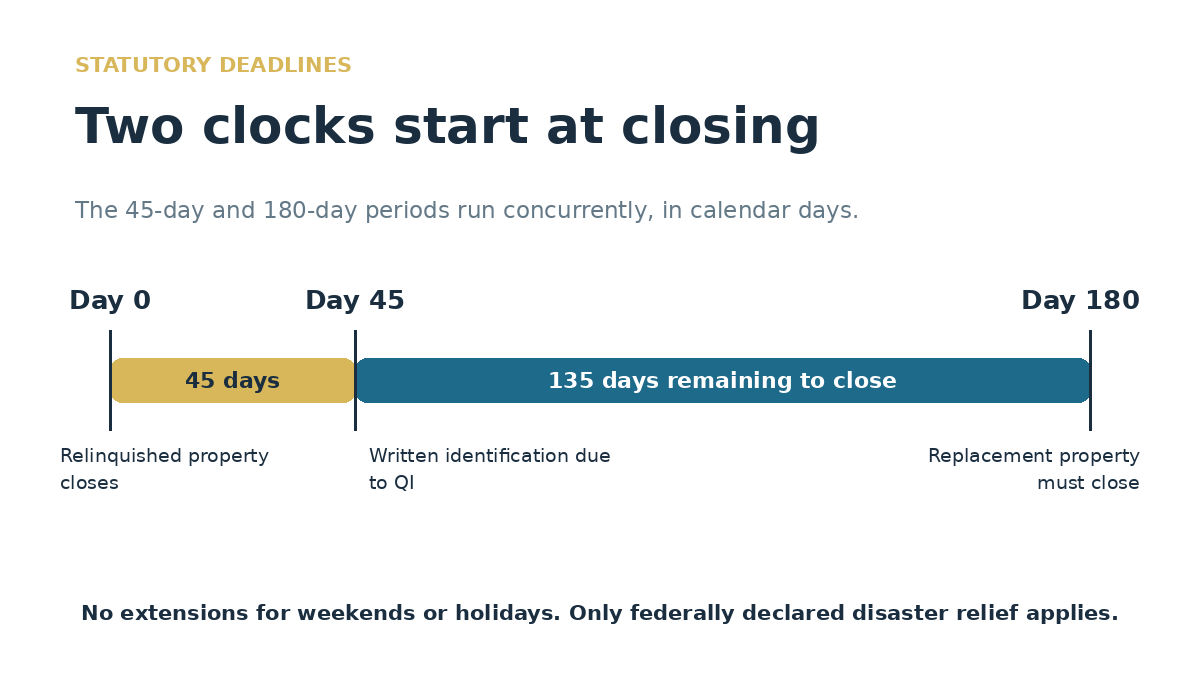
The 45-day identification window is the most intense, time-sensitive phase of a 1031 tax-deferred exchange. Day 1 of the 45-day clock begins on the exact calendar day after the relinquished property closes escrow and legal title transfers to the buyer. From that midnight moment, the seller (known as the taxpayer) has precisely 45 consecutive calendar days to identify potential replacement properties in writing.
It is critical to emphasize to your seller that the IRS counts calendar days, not business days. Weekends, federal holidays, and extreme weather events do not pause or extend the 45-day counter. To satisfy IRS requirements, the property identification must be a written document signed by the taxpayer and delivered to an independent third party—most commonly the Qualified Intermediary—before 11:59 PM on the 45th day.
Under IRS regulations, investors must adhere to one of three statutory identification rules when selecting potential replacement properties:
- The 3-Property Rule: The taxpayer may identify up to three properties of any dollar value. This is the simplest and most widely used rule among residential and small commercial investors.
- The 200% Rule: The taxpayer may identify any number of properties, provided their aggregate fair market value does not exceed 200% of the aggregate fair market value of the relinquished property sold.
- The 95% Rule: The taxpayer may identify more than three properties with an aggregate value exceeding 200%, but only if they ultimately acquire at least 95% of the total value of all identified properties—a high-risk strategy rarely utilized in standard practice.
The 180-Day Exchange Completion Window
The 180-day exchange completion window represents the total allowable time for the seller to acquire title to their designated replacement property (or properties). Similar to the identification period, the 180-day clock begins on the day immediately following the closing of the relinquished property.
Crucially, the 45-day identification window and the 180-day completion window run concurrently, not consecutively. The seller does not get 45 days plus an additional 180 days; rather, the entire exchange must be fully completed within 180 calendar days from the initial closing date.
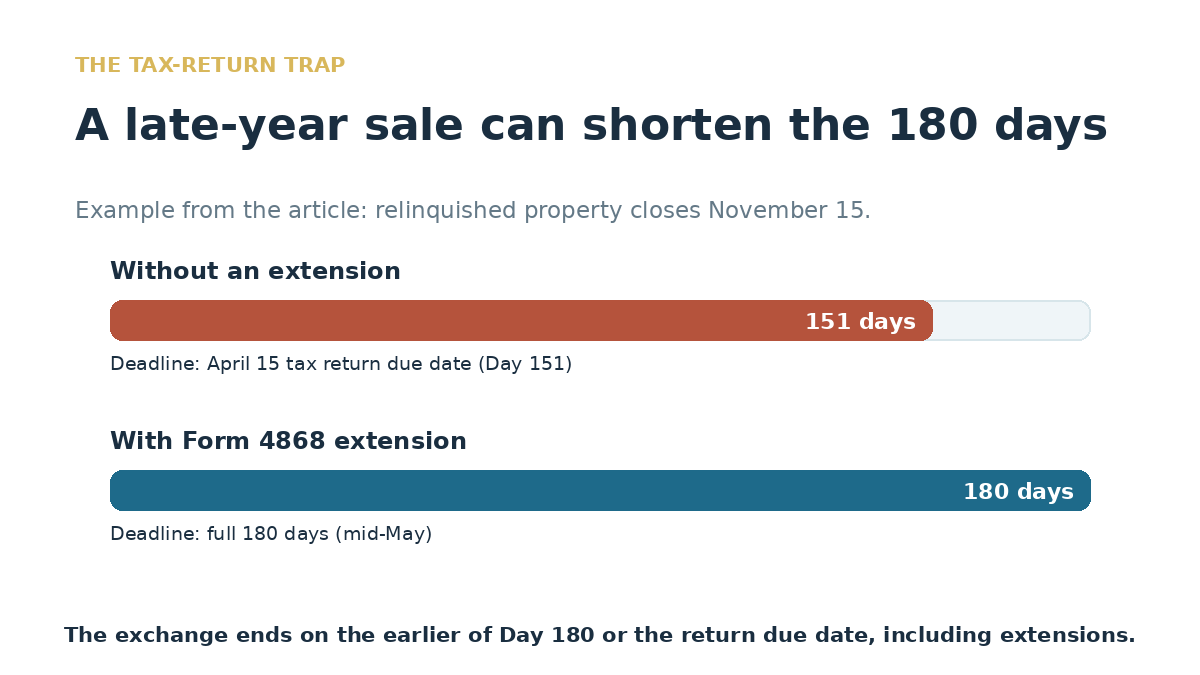
Furthermore, there is a subtle statutory trap regarding the 180-day rule: the exchange must be completed within 180 days OR by the due date (including extensions) of the taxpayer's federal income tax return for the tax year in which the relinquished property was transferred, whichever is earlier. If a seller closes a relinquished property late in the calendar year (e.g., November 15th), their tax return filing date of April 15th arrives in only 151 days. To preserve the full 180 days, the seller must file a formal tax extension (Form 4868) before filing their annual return.
Why These Deadlines Are Non-Negotiable
The IRS treats 1031 exchange deadlines as absolute statutory limits. Neither the Internal Revenue Service, the Treasury Department, nor local courts possess the legal discretion or authority to grant deadline extensions for personal emergencies, lender financing delays, title hiccups, or escrow disputes.
The only narrow exception recognized by the IRS falls under Revenue Procedure 2018-58, which grants deadline extensions strictly to taxpayers affected by federally declared natural disasters or military combat operations. Outside of these rare Presidentially declared disasters, missing the 45-day or 180-day deadline by even a single minute disqualifies the entire exchange. When an exchange fails, the seller immediately incurs full capital gains tax liabilities, state tax obligations, and depreciation recapture penalties on the entire gain realized from the sale.
How 1031 Exchange Timelines Affect Your Sales Process
Mastering 1031 exchange mechanics transforms how you handle every stage of an investment listing. When you understand what a seller actually needs to know about 1031 exchange timelines before they close, you can proactively align property marketing, buyer negotiations, and escrow schedules to protect your client's tax-deferral goals.
When to Ask a Seller About 1031 Status
The single biggest operational mistake real estate agents make is waiting until an offer arrives to inquire about a seller's tax objectives. The optimal moment to bring up 1031 exchanges is during your initial listing presentation or pre-listing property walkthrough.
When conducting discovery with a seller who owns non-owner-occupied real estate—whether a single-family rental, commercial strip center, or vacant land held for investment—ask targeted questions regarding their post-sale capital deployment:
- "Are you planning to reinvest the equity from this property into another real estate asset?"
- "Have you discussed potential capital gains exposure and tax-deferral strategies with your CPA?"
- "Do you have a Qualified Intermediary lined up to hold exchange proceeds at closing?"
By introducing the 1031 exchange conversation before the property goes live on the MLS, you give your seller ample runway to consult their tax advisors, engage a reputable QI, and begin browsing replacement inventory long before their 45-day statutory clock starts ticking.
How Timeline Awareness Changes Your Listing Strategy
Understanding the 45-day compression window fundamentally changes how you market and position the relinquished property. If a seller knows they will face a tight 45-day replacement search, you can structure the sales campaign to give them maximum flexibility.
Consider these tactical listing adjustments for 1031 sellers:
- Extended Escrow Timelines: Negotiate a 60-day or 90-day closing period with the buyer. This extended escrow gives your seller extra time to research replacement property markets, tour inventory, and draft purchase offers before their relinquished property closes and triggers the 45-day clock.
- Seller Rent-Back Clauses: Include a leaseback provision allowing the seller to remain as a tenant or delay physical possession, providing a smooth operational transition while replacement property searches are underway.
- Pre-Sourcing Inventory: Connect your seller with local commercial brokers or regional inventory channels (such as Delaware Statutory Trusts or local net-lease retail) so they have a pre-screened list of replacement candidates ready to identify on Day 1.
The Ripple Effect on Closing Negotiations
When representing a 1031 seller during offer negotiations, the transaction timeline becomes just as important as the contract purchase price. A higher offer with an unpredictable, short-notice closing date may actually be inferior to a slightly lower offer from a pre-approved buyer willing to accommodate an extended or flexible closing schedule.
Additionally, every purchase contract executed by a 1031 exchange seller must include a formal 1031 Cooperation Clause. This clause explicitly notifies the buyer that the seller intends to structure the sale as a 1031 exchange and requests the buyer's cooperation in executing assignment documents. Establishing clear contract language during negotiations ensures escrow, title, and lender partners are fully aligned well before closing.
Common Timeline Mistakes Sellers Make (And How You Prevent Them)
Even experienced real estate investors frequently fall victim to widespread myths regarding 1031 exchange timeline rules. As their real estate advisor, your job is to identify these misconceptions early and establish the facts before missteps compromise their tax deferral.
Misconception #1: "I Have Time to Figure This Out Later"
Many sellers assume they can close the sale of their investment property, deposit the sale proceeds into their personal or business bank account, and then decide within a month or two whether they want to execute a 1031 exchange.
The Reality: The moment a seller or their agent receives direct or indirect control over sale funds—a legal condition known as constructive receipt—the option to perform a 1031 exchange is permanently destroyed. To execute a valid exchange under Treasury Regulations, a Qualified Intermediary must be formally retained and assigned into the purchase contract prior to the closing of escrow. The net proceeds must flow directly from title/escrow into a segregated exchange escrow account managed by the QI.
Misconception #2: "The Clock Starts When I Close"
Sellers often operate under the vague impression that "closing" refers to when their mortgage payoff clears, when their wire arrives, or when they physically sign documents at the title company.
The Reality: Day 1 of both the 45-day identification period and the 180-day exchange completion period begins on the day after title recordation—the official date deed transfer is recorded in public county records. If a property records on Friday afternoon, Day 1 begins on Saturday morning. Sellers who delay counting until the following Monday or wait for bank wire confirmations risk miscalculating their statutory deadline by several critical days.
Misconception #3: "My CPA Will Handle All the Timing"
Investors frequently rely on their Certified Public Accountant to manage all financial details of a transaction, assuming the CPA will handle timeline tracking and intermediary setup.
The Reality: While CPAs provide essential tax planning and file Form 8824 (Like-Kind Exchanges) during tax season, they rarely act as transaction coordinators during active escrow. CPAs generally do not set up exchange accounts, draft assignment agreements, or monitor daily 45-day identification deadlines. Unless the seller works directly with an experienced real estate agent and a Qualified Intermediary, crucial timeline milestones can easily slip through the cracks.
Working with Qualified Intermediaries: The Timeline Connection
A Qualified Intermediary (QI)—also referred to as an exchange accommodator or facilitator—is the essential operational engine of a 1031 exchange. Under Treasury Regulation § 1.1031(k)-1(g)(4), a QI is a neutral third-party entity that holds exchange funds, prepares legal exchange documentation, and prevents the seller from taking constructive receipt of sale proceeds.
Why QI Involvement Starts Before You Close
Engaging a Qualified Intermediary cannot be treated as an post-closing administrative task. A QI must be fully onboarded and integrated into the transaction before closing documents are finalized.
Specifically, the QI must prepare several mandatory legal instruments prior to closing:
- The Exchange Agreement: The primary contract between the seller and the QI outlining exchange terms and fund restrictions.
- The Assignment of Relinquished Property Contract: Assigning the seller's rights in the sales agreement to the QI.
- Notice of Assignment: Formally notifying the buyer that rights have been assigned to the QI, satisfying IRS disclosure rules.
If closing occurs without these documents executed and in place, the closing officer will wire funds directly to the seller or their general account, triggering immediate tax recognition.
What Happens If You Don't Have a QI Lined Up
If a seller attempts to set up an exchange after escrow has closed, the exchange is invalid on arrival. Neither title companies, attorneys, nor accountants can retroactively fix constructive receipt.
When an exchange fails due to missing QI coordination:
- Immediate Tax Obligation: All federal capital gains taxes (up to 20%), net investment income tax (3.8%), state capital gains taxes, and depreciation recapture (25%) become due for the tax year of the sale.
- Loss of Reinvestment Equity: The seller loses 20% to 40% of their total accumulated equity to taxes, dramatically reducing their purchasing power for future real estate acquisitions.
x1031 Exchange and Your Timeline Planning
Partnering with an experienced, institutional-grade accommodator like x1031 Exchange ensures your sellers receive complete structural support throughout the exchange lifecycle. Qualified Intermediary teams provide custom timeline tracking tools, digital property identification forms, and secure escrow accounting to eliminate deadline anxiety.
By introducing your seller to x1031 Exchange during pre-listing planning, you establish a seamless coordination bridge between the listing agent, buyer's agent, title company, lender, and tax advisor, guaranteeing that every statutory deadline is tracked and satisfied.
Real-World Timeline Scenarios: When Deals Intersect with Deadlines
To illustrate how 1031 exchange timelines operate during active transactions, let's examine three common real-world scenarios real estate agents encounter in today's market.
Scenario 1: Seller Finds New Property Before 45 Days
The Situation: Sarah lists and sells a fourplex in a high-demand urban market. Escrow closes on June 1st. On June 10th (Day 9 of her 45-day window), Sarah tours a modern suburban office building and decides it is the perfect replacement property.
The Execution: Rather than waiting until Day 45, Sarah immediately completes a formal written identification form provided by her Qualified Intermediary, listing the office building address. She signs and delivers the form to her QI on June 12th. Because she identified her target early, Sarah spends the remaining 168 days of her 180-day window conducting physical due diligence, securing commercial financing, and completing the acquisition smoothly on August 15th—well ahead of all IRS deadlines.
Scenario 2: Seller in Contract During the 180-Day Window
The Situation: Marcus sells a commercial warehouse on October 1st. He identifies three potential replacement properties on Day 30 of his identification period. On Day 60, he executes a purchase contract for his top-choice replacement property with a targeted closing date of December 15th.
The Execution: On December 5th, the buyer's lender on the replacement property encounters underwriting delays and requests a 30-day closing extension into mid-January. Because Marcus established a 180-day completion window that extends until late March, he can safely grant the lender's requested extension without endangering his 1031 exchange status. His timeline cushion keeps the transaction completely compliant.
Scenario 3: Market Conditions Delay the Replacement Property Purchase
The Situation: Elena closes the sale of a retail strip center on March 1st. She identifies two properties under the 3-Property Rule on Day 40. However, during escrow on her primary selection, environmental inspections reveal underground tank contamination, forcing her to terminate the contract on Day 90.
The Execution: Because Elena properly identified a secondary backup property on her original 45-day identification form before midnight on Day 45, she immediately shifts her focus to Property #2. She opens escrow on the backup candidate and successfully closes on Day 150. Had Elena failed to list a backup property during her initial 45-day window, terminating her primary deal on Day 90 would have resulted in a total exchange failure.
Positioning Yourself as the Realtor Who Understands 1031 Exchanges
Demonstrating deep expertise in 1031 exchange mechanics is one of the most effective ways to differentiate yourself in competitive real estate markets. Investment property owners want to work with professionals who protect their wealth, understand complex tax strategies, and manage transaction timelines with precision.
Why Your Knowledge of Timelines Closes More Deals
When an investor evaluates real estate agents to list a multi-million-dollar asset, they aren't just looking for social media marketing or pretty property photos—they are looking for transaction expertise. Showing a seller that you understand constructive receipt, the 3-property rule, and strict 45/180-day mechanics instantly establishes high professional authority.
When you articulate what a seller actually needs to know about 1031 exchange timelines before they close, you transform from a transactional agent into a trusted strategic advisor. Investors return to agents who safeguard their capital, leading to repeat listings, buy-side representation on replacement acquisitions, and valuable peer referrals.
The Conversation Starters That Work
Here are three tested conversation scripts you can use with investment property sellers during pre-listing discovery:
- The Equity Protection Script: "If we achieve our target listing price on this property, you'll be realizing substantial capital gains. Have you and your CPA reviewed how a 1031 exchange could defer those taxes so you can roll 100% of your equity into your next investment?"
- The Timeline Preparation Script: "Once we record title on your sale, the IRS gives us exactly 45 days to formally identify replacement inventory. To make those 45 days stress-free, let's start surveying replacement properties and reviewing market inventory right now before we go live."
- The QI Alignment Script: "To ensure your exchange is completely compliant, we need to have a Qualified Intermediary assigned to the contract before closing. I partner with experienced accommodators like x1031 Exchange who handle fund security and document setup so your closing is seamless."
Your Competitive Edge
In every market, the majority of agents focus exclusively on single-family home sales and basic consumer transactions. By mastering 1031 exchange timelines, debt replacement rules, and qualified intermediary coordination, you position yourself in the lucrative investment tier of the real estate industry. You earn higher commissions, build long-term investor client relationships, and establish a resilient business built on repeatable commercial and residential investment deals.
Common Questions
Frequently Asked Questions
Bringing up a 1031 exchange should always feel like proactive client care rather than a sales pitch. Frame the conversation around equity protection and tax planning during your initial listing presentation. Ask open-ended questions such as, 'Are you planning to reinvest the proceeds from this sale into another real estate asset?' or 'Has your CPA discussed potential capital gains exposure with you?' Position yourself as an advisor who wants to help them preserve wealth. Mentioning that exchange rules require pre-closing setup with a Qualified Intermediary allows you to introduce the topic naturally. This educational approach highlights your expertise, protects your client from accidental tax exposure, and gives them control over their financial decisions.
Before putting an investment property on the market, ask the seller four critical discovery questions. First, ask, 'Is this property held for investment or business use?' to confirm eligibility. Second, ask, 'What is your estimated cost basis and potential capital gains liability?' to gauge tax impact. Third, ask, 'Have you selected a Qualified Intermediary, or would you like a recommendation?' to ensure early setup. Fourth, ask, 'Do you have target replacement properties in mind, or do we need to start sourcing inventory now?' Asking these questions before listing allows you to negotiate appropriate closing timelines, incorporate required 1031 contract clauses, and prevent panic during the 45-day identification window.
The single costliest mistake sellers make is taking constructive receipt of sale proceeds at closing without engaging a Qualified Intermediary beforehand, which instantly invalidates the exchange. Another frequent error is assuming the 45-day and 180-day clocks count business days rather than calendar days, leading to missed deadlines over weekends or holidays. Sellers also fail to realize that the 45-day identification and 180-day completion periods run concurrently starting the day after title transfer. Finally, sellers often identify only one replacement property without backup candidates, leaving them vulnerable to complete tax exposure if that single deal falls apart during due diligence or financing review.
If a seller fails to properly identify replacement property in writing by 11:59 PM on the 45th calendar day following closing, the 1031 exchange fails completely. The IRS grants zero extensions or exceptions for missed identification deadlines, even for financing issues or escrow delays. Consequently, the sale becomes fully taxable in the year of disposition. The seller incurs federal capital gains taxes up to 20%, net investment income tax of 3.8%, state taxes, and a 25% depreciation recapture tax. Furthermore, exchange funds held by the Qualified Intermediary generally remain locked until the 45-day or 180-day period expires under Treasury Regulation § 1.1031(k)-1(g)(6).
A seller might decline a 1031 exchange if they need liquid cash for personal uses, debt reduction, or non-real estate investments. Some investors face minimal tax exposure due to low capital gains, offsetting capital losses, or high original cost basis, making exchange setup costs unnecessary. Others choose to pay taxes to exit property management entirely, avoiding the hassle of maintaining replacement real estate. Additionally, investors unable to find suitable replacement properties within strict 45-day deadlines may decide that rushing into a poor investment carries greater risk than paying capital gains taxes. Understanding these motives helps you tailor your strategy to their goals.
When a seller enters a purchase contract while planning a 1031 exchange, negotiation timelines focus heavily on escrow flexibility. The seller often requests an extended closing period—such as 60 or 90 days—to pre-screen replacement properties before their 45-day clock begins at closing. The purchase contract must also include a 1031 exchange cooperation clause, notifying the buyer of the exchange and securing their agreement to execute assignment documents. Furthermore, if financing or title issues delay the closing date of the relinquished property, the agent must ensure all parties adjust escrow smoothly, as the official statutory exchange clock triggers only upon deed recordation.
Most realtors avoid discussing 1031 exchanges because they fear tax complexity or assume it requires giving legal advice. Others simply lack training on 1031 rules and timelines. This knowledge gap costs agents significant business: they lose listing opportunities to specialized commercial brokers and miss out on representing the same client on their replacement property acquisition. By ignoring 1031 exchanges, agents forfeit dual-transaction commission potential and risk damaging client relationships if an unadvised seller suffers a massive, avoidable tax bill. Mastering basic 1031 timeline mechanics establishes high professional authority, drives valuable client referrals, and unlocks lucrative repeat investment transactions across your target market.
Conclusion
Navigating 1031 exchange timelines requires vigilance, clear client communication, and strict adherence to IRS rules. As a real estate agent, remembering three core takeaways will keep your deals on track: first, the 45-day identification and 180-day exchange windows count consecutive calendar days starting the day after title recordation; second, a Qualified Intermediary must be engaged before escrow closes to prevent fatal constructive receipt; and third, starting property discovery before going live on the MLS gives your sellers the ultimate competitive advantage. By mastering these timeline mechanics, you protect your clients' equity and position yourself as an expert investment advisor.
Partner with x1031 Exchange
To deepen your 1031 exchange expertise, access timeline planning tools, or connect your seller clients with experienced accommodators, visit x1031.com. Partnering with the professional team at x1031 Exchange ensures your transactions remain fully compliant, seamlessly coordinated, and stress-free from listing to closing.
Start your client's exchange →Disclaimer
This guide is provided for educational and informational purposes only and does not constitute formal legal, tax, or financial advice. 1031 exchange rules under Internal Revenue Code Section 1031 are subject to strict legal and regulatory interpretation. Real estate professionals, sellers, and investors should always consult with a qualified CPA, tax attorney, or licensed Qualified Intermediary regarding specific transaction structures and individual tax obligations.
Sources and official references
- Like-Kind Exchanges: Real Estate Tax Tips, Internal Revenue Service
- 26 U.S. Code § 1031, Exchange of Real Property Held for Productive Use or Investment, Cornell LII
- 26 CFR § 1.1031(k)-1, Treatment of Deferred Exchanges, Cornell LII
- Revenue Procedure 2018-58, Postponement for Federally Declared Disasters, IRS
- About Form 8824, Like-Kind Exchanges, IRS
- About Form 4868, Application for Automatic Extension of Time to File, IRS