REALTOR 1031 EXCHANGE GUIDE
1031 Exchange Checklist for Realtors: The Agent's Guide to Listing, Timelines, and Closing
Your client just closed on a commercial rental property, netting $1.2 million in taxable gain. They have exactly 45 days to formally identify a replacement property and 180 days to close title—or face an immediate, six-figure tax bill from the IRS. Are you equipped to keep their transaction on schedule, or will a single missed operational milestone trigger a catastrophic tax liability? For real estate agents and brokers, mastering tax-deferred exchanges under Internal Revenue Code Section 1031 is no longer an optional skill reserved for specialized commercial practitioners. It is an essential operational core competency that protects investor equity, unlocks off-market listings, and drives multi-transaction commission volume.
IN THIS GUIDE
A four-phase checklist from listing to replacement closing
How exchanges work
The transaction flow, which properties qualify, and why the QI holds the proceeds.
The checklist
Pre-listing, contract, identification, and closing steps agents can run on every deal.
Mistakes to avoid
Touching funds, mortgage boot, and miscounted statutory deadlines.
Why Every Realtor Should Understand 1031 Exchanges—And Why Many Don't
A Section 1031 exchange allows real estate investors to defer 100% of federal capital gains taxes, state capital gains taxes, net investment income tax (NIIT), and depreciation recapture when selling investment real estate, provided all sale proceeds are reinvested into a qualifying like-kind replacement property. Despite these massive financial incentives, a surprising number of licensed real estate professionals avoid exchange transactions due to perceived complexity, fear of administrative liability, or unfamiliarity with IRS regulations.
The Advisor Advantage: Moving Beyond Transactional Brokerage
In a competitive real estate market, property owners do not merely seek agents who can post listings to the Multiple Listing Service (MLS). They demand strategic advisors who understand wealth preservation, portfolio scaling, and capital efficiency. When you understand how to explain a 1031 exchange to clients proactively, you transition from a commodity service provider to an irreplaceable partner in their long-term real estate strategy.
- Client Retention: Investors who defer capital gains taxes have substantially more buying power, allowing them to purchase larger, higher-yielding replacement properties with your representation.
- Double-Sided Deal Velocity: Because every 1031 exchange requires selling a relinquished property and buying a replacement property, a single exchange client frequently translates into two distinct commission transactions.
- Unlocking Dormant Inventory: Many property owners hesitate to sell highly appreciated rental assets because they fear losing 20% to 40% of their equity to tax liabilities. Demonstrating a clear tax-deferral path removes this friction and unlocks listing inventory.
Why Many Agents Avoid Exchange Transactions
The primary reason agents shy away from 1031 exchanges is the risk of transactional failure. A missed deadline or an improper contract clause can jeopardize the entire tax deferral, creating friction between the seller and their professional team. However, when realtors utilize a standardized operational framework—such as the resources provided by platforms like x1031 Exchange—they can navigate complex deals with complete compliance confidence while directing clients to credentialed tax and legal experts.
How 1031 Exchanges Work: A Step-by-Step Breakdown for Realtors
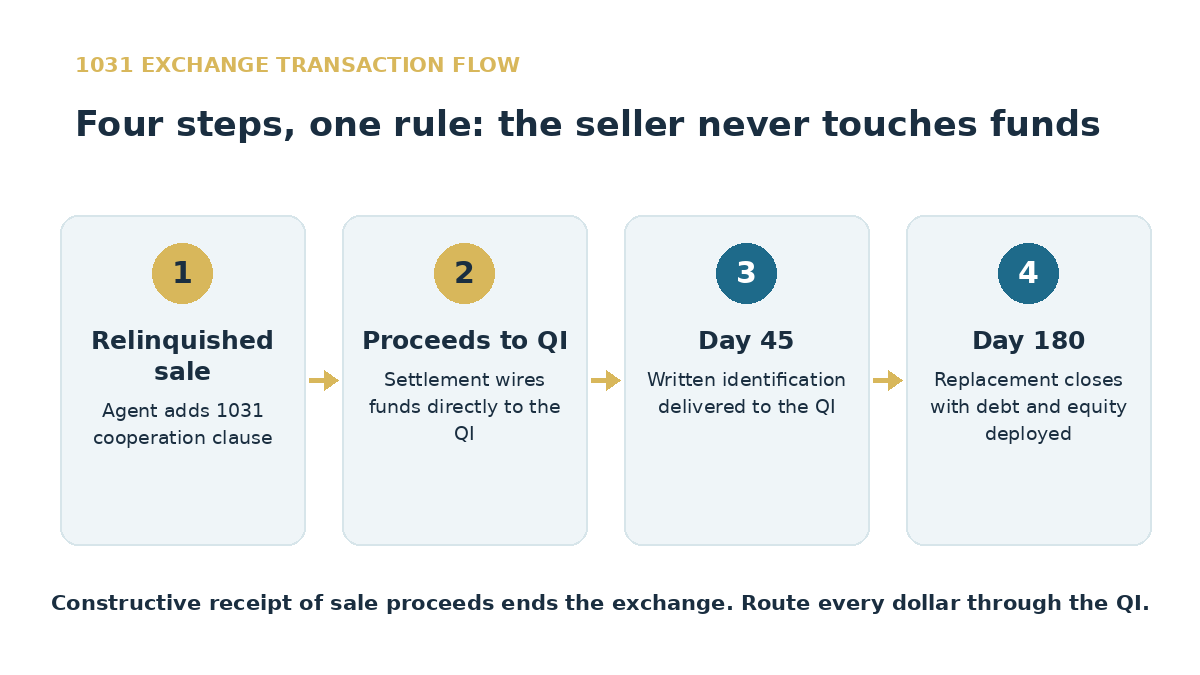
To guide clients effectively, realtors must understand how a 1031 exchange works step by step for realtors without providing formal tax or legal counsel. The underlying mechanics rely on strict administrative separation between the property seller and the sale proceeds.
The Basic Definition and Tax Deferral Benefit
Under Section 1031, an investor exchanges one qualifying investment asset for another. It is vital to emphasize to clients that a 1031 exchange is a tax-deferral strategy, not a tax-elimination loophole. Tax liabilities are rolled forward into the replacement property's adjusted basis. If the investor continues to exchange properties throughout their lifetime and holds the final property until death, their heirs receive a step-up in cost basis to current market value, effectively eliminating the accumulated tax burden permanently under current tax law.
What Types of Properties Qualify?
Realtors must be adept at evaluating 1031 exchange qualifying properties. The Tax Cuts and Jobs Act (TCJA) restricted Section 1031 treatment strictly to real property held for productive use in a trade, business, or investment.
| Property Category | IRS 1031 Qualification Status | Key Agent Considerations |
|---|---|---|
| Residential Rental Properties | Fully Qualifying | Single-family rentals, duplexes, multi-family units held for income. |
| Commercial Real Estate | Fully Qualifying | Retail strip centers, office buildings, industrial warehouses, self-storage. |
| Vacant Land & Farmland | Fully Qualifying | Raw land held for investment or agricultural trade. |
| Primary Personal Residences | Strictly Non-Qualifying | Covered under Section 121 exclusions, not Section 1031. |
| Fix-and-Flip Properties | Strictly Non-Qualifying | Classified as inventory held primarily for sale; subject to ordinary income tax. |
| Vacation / Second Homes | Conditionally Qualifying | Must satisfy IRS Revenue Procedure 2008-16 safe harbor rental rules. |
The IRS defines "like-kind" extremely broadly regarding real property. A client can exchange a single-family rental house for a commercial warehouse, raw land for a multi-family apartment complex, or an industrial building for a portfolio of residential rentals.
The Absolute Necessity of the Qualified Intermediary
The cornerstone of every valid 1031 exchange is the Qualified Intermediary (QI), also known as an Exchange Accommodator. Under Treasury Regulations, the seller cannot receive or control the sale proceeds at any point during the transaction. If the seller takes direct possession of the closing funds—or if the funds are deposited into the seller's personal bank account—the IRS None deems the seller in "constructive receipt" of the money. Constructive receipt instantly invalidates the exchange, making the entire gain immediately taxable.
The QI prepares the formal exchange agreement, holds the net sale proceeds in a segregated escrow account, and disburses the funds directly to the closing attorney or settlement agent upon acquisition of the replacement property. Platform resources like x1031 Exchange help realtors connect clients with vetted QIs early in the pre-listing phase.
The Critical Deadlines and Timelines Realtors Must Know
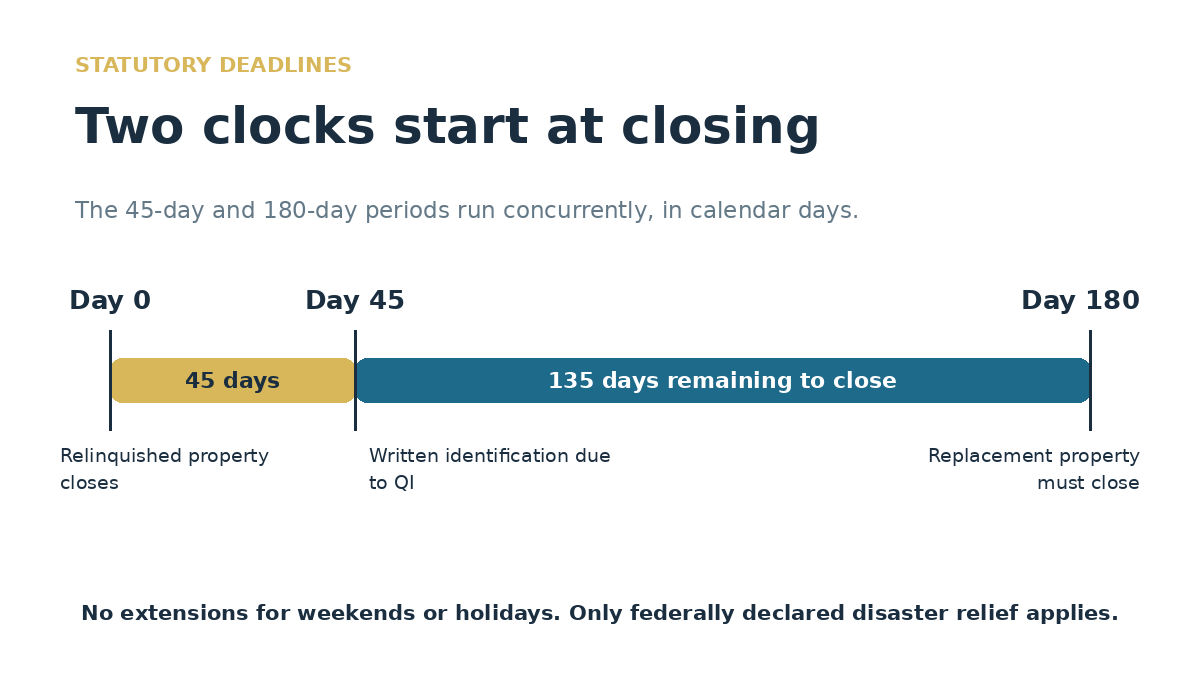
Timing is the single greatest point of failure in exchange management. The IRS deadlines in a 1031 exchange are statutory, non-negotiable calendar day limitations. There are no extensions for weekends, national holidays, adverse weather conditions, or delayed property inspections.
The 45-Day Identification Period
The 45-day clock begins on the exact calendar date the relinquished property closing takes place (Day 0). By midnight of Day 45, the investor must deliver a unambiguous, signed, written identification document to the Qualified Intermediary listing potential replacement properties.
To maintain strict compliance, the IRS mandates that investors select properties using one of three specific statutory rules:
- The 3-Property Rule: The investor may identify up to three potential replacement properties of any dollar value. This is the most common identification strategy used by real estate clients.
- The 200% Rule: The investor may identify any number of properties, provided their aggregate combined fair market value does not exceed 200% of the total aggregate sale price of the relinquished property.
- The 95% Rule: The investor may identify any number of properties regardless of total value, but must acquire at least 95% of the aggregate value of all identified properties before the deadline.
The 180-Day Exchange Period
The investor must complete the purchase and close title on the replacement property within 180 calendar days after the relinquished property closing date, or by the due date (including extensions) of the investor's federal income tax return for the tax year in which the transfer occurred, whichever is earlier. The 45-day identification period runs concurrently with the 180-day exchange period; it does not add additional time.
The 1031 Exchange Checklist: Essential Steps Before, During, and After the Exchange
To streamline deal execution and protect clients from administrative oversights, real estate agents should implement this comprehensive 1031 exchange checklist for realtors across every phase of the transaction.
Phase 1: Pre-Listing and Discovery Checklist (Before Going Live)
- Identify Client Intent: Ask every prospective seller during the initial listing presentation whether the property is an investment asset and if they plan to utilize a 1031 exchange.
- Verify Property Qualification: Confirm the property has been held for investment or business use, verifying it is not a fix-and-flip asset or personal residence.
- Calculate Estimated Basis and Gain: Encourage the client to review their adjusted basis, accumulated depreciation, and potential tax liability with their CPA or tax advisor.
- Introduce the Qualified Intermediary: Ensure the client selects and retains a Qualified Intermediary before signing binding contract agreements or closing the sale.
- Analyze Debt and Equity Replacement Requirements: Determine the current debt balance on the relinquished property to plan for equal or greater debt replacement on the purchase side.
Phase 2: Listing & Purchase Contract Checklist (Active Marketing to Closing)
- Insert 1031 Contract Cooperation Language: Add mandatory exchange cooperation addenda to the purchase and sale agreement, notifying the buyer that the seller intends to execute a 1031 exchange at no additional cost or liability to the buyer.
- Coordinate with Settlement Officers: Ensure the closing attorney or title company sends draft Settlement Statements (HUD-1/Closing Disclosure) to the QI for approval prior to closing.
- Verify Escrow Funds Transfer: Confirm that 100% of net sale proceeds are wired directly from the closing agent to the QI's segregated escrow account.
- Confirm Closing Date (Day 0): Establish the official closing date that marks Day 0 for the 45-day and 180-day statutory clocks.
Phase 3: Replacement Property Identification Checklist (Days 1 to 45)
- Launch Immediate Replacement Search: Do not wait for closing to begin evaluating replacement options; initiate market analysis and pro-forma reviews weeks before closing.
- Apply Identification Rules: Assist the client in selecting candidates under the 3-Property Rule or 200% Rule.
- Submit Written Notice to QI: Verify that the client delivers a signed, formal written identification document to the Qualified Intermediary before midnight on Day 45.
- Structure Purchase Offers: Include 1031 buyer cooperation language in purchase contracts for replacement properties.
Phase 4: Replacement Property Closing Checklist (Days 46 to 180)
- Finalize Financing Requirements: Coordinate with investor mortgage lenders to ensure loan approval, underwriting, and DSCR metrics align with replacement equity requirements.
- Execute Assignment of Contract: Ensure the contract rights for the replacement property are assigned to the QI prior to closing.
- Direct QI Wire Transfer: Confirm the QI wires escrowed exchange proceeds directly to the settlement agent for closing.
- Complete Title Transfer: Close title on or before Day 180 and retain all transaction records for tax filing.
Common Mistakes Realtors Make When Advising Clients on 1031 Exchanges
Even experienced agents can inadvertently expose clients to severe financial and tax risks if they fail to monitor operational details. Here are the most common mistakes realtors make and how to avoid them.
1. Allowing the Client to Touch the Funds
The single most fatal mistake is permitting closing proceeds to enter the client's bank account. Even a momentary transfer of funds establishes constructive receipt and invalidates the exchange completely. Always verify that closing documents direct proceeds straight to the QI.
2. Failing to Replace Debt and Creating Mortgage Boot
To achieve 100% tax deferral, the investor must acquire replacement property equal to or greater in net purchase value than the relinquished property, and reinvest all net cash proceeds. Furthermore, the investor must replace any debt paid off on the relinquished property with equal or greater debt on the replacement property, or offset the debt shortfall with additional cash injection. Failing to balance the capital stack results in "boot" (taxable gain realized during an exchange).
3. Miscalculating Statutory Timelines
Assuming that IRS deadlines pause for holidays or weekends is a catastrophic error. Day 45 is Day 45, regardless of whether it falls on Thanksgiving or Sunday. Agents must maintain rigorous calendar tracking to ensure written identifications and closing dates are met comfortably ahead of statutory limits. Leveraging compliance support from platforms like x1031 Exchange ensures agents never miss critical operational milestones.
How Understanding 1031 Exchanges Can Transform Your Real Estate Business
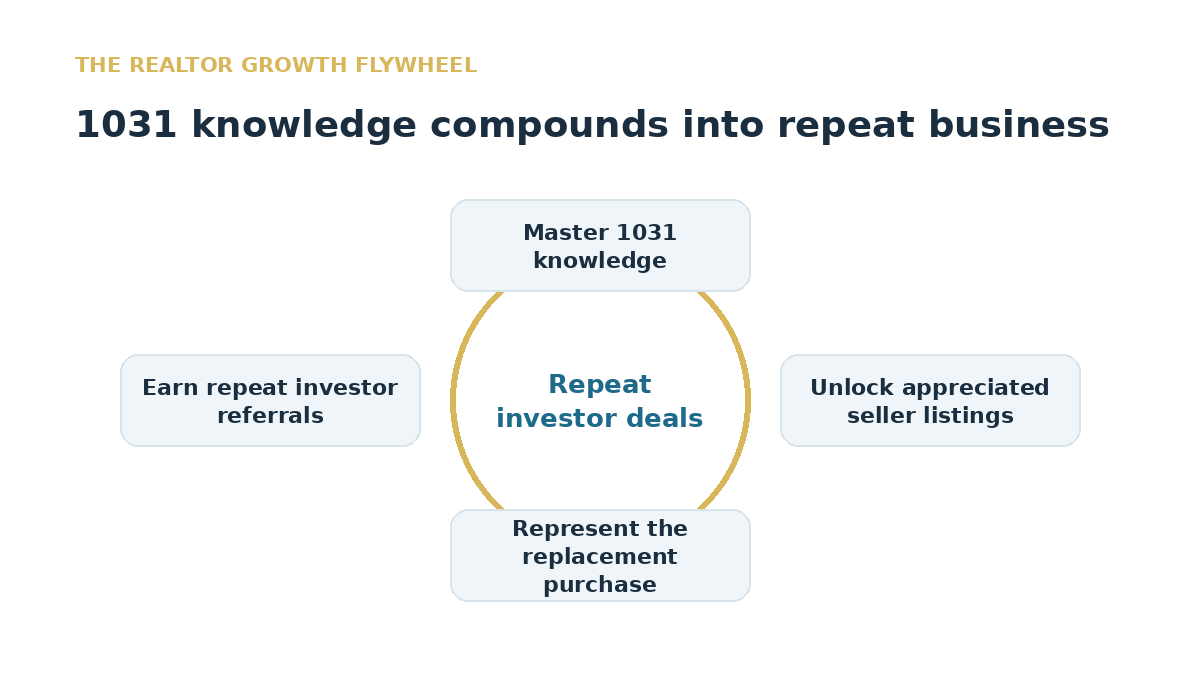
Positioning yourself as a 1031 exchange specialist fundamentally alters your business growth trajectory. Rather than competing in the crowded residential buyer pool, you unlock access to high-net-worth real estate investors, family offices, and commercial property owners.
Building Repeat and Referral Investor Relationships
Real estate investors are inherently transactional and highly active compared to traditional owner-occupants. While a typical homeowner moves once every seven to ten years, an active real estate investor may acquire or exchange multiple properties annually. When you demonstrate seamless transaction execution, track timelines flawlessly, and protect their tax-deferred gains, investors reward you with repeat listing and buying opportunities alongside referrals to their professional networks.
Marketing Your 1031 Expertise Effectively
To establish leadership in your local market, integrate 1031 exchange educational content into your digital marketing strategy. Host educational webinars for local property owners, publish market-specific capitalization rate analyses, and distribute transaction checklists. When you market yourself as an investor-focused realtor who coordinates seamlessly with Qualified Intermediaries, lenders, and CPAs, you build a resilient, recession-resistant real estate practice.
Common Questions
Frequently Asked Questions
A 1031 exchange, authorized under Section 1031 of the Internal Revenue Code, allows real estate investors to defer capital gains taxes and depreciation recapture when selling an investment property and reinvesting the net proceeds into a like-kind replacement property. For real estate agents and brokers, mastering the 1031 exchange framework is a powerful business driver. Because a single exchange transaction involves both the sale of a relinquished property and the purchase of a replacement property, knowledgeable agents frequently represent clients on both sides of the deal. Furthermore, understanding tax deferral mechanics helps agents unlock inventory, advise property owners on wealth preservation, and build long-term relationships with active real estate investors. Always encourage clients to consult with a qualified tax professional.
A 1031 exchange follows a strict operational sequence that agents must navigate smoothly alongside their clients. First, the agent identifies the client's intent to exchange during pre-listing consultation and inserts mandatory 1031 cooperation clauses into the purchase agreement. Second, before the relinquished property closing occurs, the investor contracts with a Qualified Intermediary (QI) to hold the sale proceeds in escrow. Third, upon closing, the strict 45-day identification clock begins, requiring the client to formally designate potential replacement properties in writing. Fourth, the client must complete the acquisition of the replacement property within 180 days of the initial closing. Throughout every stage, the agent coordinates timelines with the lender, escrow officer, and QI while reminding clients to consult tax advisers.
Realtors assisting exchange clients must strictly monitor two non-negotiable statutory timelines set by the IRS. Both clocks start on the exact date the relinquished property deed is transferred at closing. The first deadline is the 45-Day Identification Period, during which the investor must deliver a signed, written document to the Qualified Intermediary specifying potential replacement properties. The second deadline is the 180-Day Exchange Period, within which the investor must complete the purchase and close title on the replacement property. These statutory calendar days include weekends and holidays without exception. Missing either deadline by even a single minute completely disqualifies the exchange, triggering immediate capital gains tax liabilities. Realtors play a vital role in keeping transactions moving briskly to protect client timelines.
The most frequent error realtors commit is failing to engage a Qualified Intermediary before the relinquished property closing. If the seller directly receives or controls sale proceeds at closing—even for a few seconds—constructive receipt occurs, permanently invalidating the exchange. Another common mistake is providing informal legal or tax advice regarding debt replacement or boot calculations rather than directing clients to credentialed advisers. Agents also frequently miscalculate statutory timelines by assuming business days apply instead of strict calendar days, or fail to include required 1031 cooperation and assignment clauses in purchase contracts. Finally, recommending non-qualifying property types, such as personal residences or fix-and-flip inventory, can create major tax liabilities for clients. Working alongside platform resources like x1031 Exchange helps agents maintain strict compliance.
To qualify for Section 1031 tax deferral, both the relinquished property and the replacement property must be held for productive use in a trade or business or for investment purposes. Under the Tax Cuts and Jobs Act, qualifying property is limited exclusively to real property. The IRS applies a broad definition of 'like-kind' real estate, meaning investors can exchange across different property categories—such as swapping a single-family rental for a multi-family apartment building, commercial office space, industrial warehouse, or vacant land. However, primary residences, secondary vacation homes used exclusively for personal enjoyment, property held primarily for sale (such as developer inventory or fix-and-flip houses), partnership interests, and personal property strictly fail to qualify under IRS regulations. Always verify property eligibility with a tax professional.
If an investor fails to formally identify replacement properties in writing to the Qualified Intermediary by midnight of the 45th calendar day following closing, the 1031 exchange is immediately terminated. Under IRS regulations, the Qualified Intermediary is legally prohibited from extending the deadline, regardless of extenuating circumstances such as illness, severe weather, or market inventory shortages. Once the window expires without a valid identification, the exchange fails, the escrow proceeds are released to the seller, and the entire sale becomes a fully taxable event. The client faces immediate federal and state capital gains taxes, net investment income tax, and depreciation recapture. Realtors must proactively prepare property search strategies well before the relinquished closing date.
Conclusion
Mastering the 1031 exchange process is one of the most effective ways for real estate agents and brokers to elevate their practice, build lasting credibility with real estate investors, and unlock substantial transaction volume. By understanding statutory timelines, enforcing contract cooperation clauses, and maintaining a structured operational checklist from pre-listing to closing, you position yourself as an indispensable strategic advisor rather than a transactional agent. Tax-deferred exchanges allow your clients to compound their wealth, transition into higher-performing commercial or residential rental assets, and optimize their real estate portfolios. When you proactively protect client exchange timelines and collaborate seamlessly with Qualified Intermediaries, lenders, and tax professionals, you create repeatable double-sided deal opportunities while safeguarding your clients against costly compliance pitfalls.
Partner with x1031 Exchange
Ready to master the 1031 exchange landscape and position yourself as the premier real estate agent for investment clients in your market? Visit x1031.com today to access downloadable transaction checklists, investor guidebooks, and expert compliance resources. Partner with x1031.com to seamlessly connect your clients with trusted Qualified Intermediaries and mortgage specialists before your next closing.
Start your client's exchange →Disclaimer
Educational information only. x1031 Exchange does not provide legal, tax, or lending advice. Consult your qualified intermediary, attorney, tax adviser, and lender regarding your specific transaction.
Sources and official references