REALTOR 1031 EXCHANGE GUIDE
How Do I Find a Trustworthy Qualified Intermediary for My Client's 1031 Exchange? An Agent's Vetting Guide
Your client just accepted an offer to sell a $2.5 million investment property, unlocking over $800,000 in taxable gain that they plan to defer using Section 1031. They have 45 days to formally identify replacement property and 180 days to close, but as closing approaches, they casually mention they plan to hold the sale proceeds in their personal escrow account until they find the next deal. In that single moment, their tax deferral is on the verge of total collapse. If a seller receives or controls net proceeds from a relinquished property closing for even one second, the Internal Revenue Service considers it a taxable sale under the constructive receipt doctrine. As their real estate agent, your client looks to you to guide their transaction team. How do I find a trustworthy qualified intermediary for my client's 1031 exchange before a costly mistake invalidates their tax deferral? Navigating the qualified intermediary landscape requires understanding statutory duties, verifying institutional security, and avoiding common industry traps. Partnering with a vetted accommodator ensures your client's exchange proceeds remain protected, statutory deadlines are strictly met, and your reputation as a trusted investment advisor remains intact.
IN THIS GUIDE
Vetting the one party every exchange depends on
What a QI does
Exchange agreements, contract assignments, escrow, and deadline documentation.
How to vet one
Bonding, insurance, qualified escrow, banking partners, and internal controls.
Red flags
Commingled accounts, bargain fees, undisclosed banks, and disqualified persons.
Why Your Client's 1031 Exchange Success Depends on Choosing the Right Qualified Intermediary
A Section 1031 like-kind exchange allows real estate investors to defer federal and state capital gains taxes, net investment income taxes, and depreciation recapture when selling investment or business property. However, the entire legal validity of a tax-deferred exchange hinges on a single mandatory entity: the qualified intermediary (QI), also known as an exchange accommodator or accommodator. Understanding IRS 1031 exchange rules is essential for realtors advising property owners, as the intermediary serves as the financial and legal bridge between the relinquished property sale and the replacement property purchase.
Constructive Receipt and the Legal Invalidations of Self-Handled Funds
Under Treasury Regulation § 1.1031(k)-1, a taxpayer cannot take actual or constructive receipt of sale proceeds during an exchange. Constructive receipt occurs whenever net cash proceeds are credited to a seller's bank account, controlled by their agent, or held in a standard escrow account without a proper exchange agreement in place. If your client touches the funds or controls their disposition, the entire transaction becomes a fully taxable event, triggering immediate federal 1031 exchange capital gains liabilities. A qualified intermediary prevents constructive receipt by entering into an exchange agreement, taking assignment of the sale contract, and holding all net proceeds in a secure, restricted account throughout the exchange period.
Financial Security: Fidelity Bonding, Errors & Omissions, and Segregated Accounts
Surprisingly, the qualified intermediary industry is non-regulated at the federal level, meaning anyone who is not a disqualified person can technically claim to be an accommodator. This lack of federal oversight makes institutional security the single most important evaluation metric for realtors. A reputable qualified intermediary must maintain comprehensive financial protections, including a fidelity bond of at least $100 million, Errors & Omissions (E&O) insurance, and institutional performance guarantees. Furthermore, your client's funds should always be held in qualified trust or qualified escrow accounts at FDIC-insured financial institutions using segregated sub-accounts tied to your client's taxpayer identification number. Educational platforms like x1031 Exchange emphasize that institutional security measures protect investor equity against fraud, insolvency, or unauthorized fund transfers.
What a Qualified Intermediary Actually Does (and Why It Matters to Realtors)
While realtors focus on listing marketing, contract negotiation, and property sourcing, the qualified intermediary handles the legal structure and financial mechanics required to satisfy Treasury regulations. Understanding qualified intermediary duties empowers realtors to seamlessly integrate the accommodator into the transaction timeline long before closing day arrives.
Core Technical Duties: Agreement Execution and Funds Escrow
The qualified intermediary's primary responsibility is facilitating the exchange by acting as an independent party in the transaction chain. Prior to closing the relinquished property, the QI executes an Exchange Agreement with the seller and receives an assignment of the purchase and sale contract. At closing, the settlement agent transfers net sales proceeds directly to the QI's escrow account. When the replacement property is acquired, the QI receives assignment of the new purchase agreement and wires funds directly to the closing attorney or title company to complete the purchase.
| Qualified Intermediary Duty | Real Estate Agent Benefit | Compliance Impact |
|---|---|---|
| Contract Assignment & Notification | Ensures purchase agreements include proper 1031 exchange language | Prevents legal invalidation of the exchange agreement |
| Direct Proceeds Escrow | Shields client from constructive receipt of cash proceeds | Eliminates immediate capital gains tax liability |
| Identification Documentation | Receives and timestamps 45-day identification notices | Satisfies strict IRS statutory deadline requirements |
| Settlement Coordination | Transfers exchange funds directly to closing agents | Guarantees seamless replacement property funding |
Timeline Governance: Safeguard for the 45-Day and 180-Day Deadlines
A successful 1031 exchange requires strict adherence to two non-negotiable statutory timelines set by the IRS. The 45-day identification period begins on the day relinquished property title transfers, requiring the investor to formally identify potential replacement properties in writing. The 180-day exchange period governs the completion of the replacement property acquisition. A trustworthy qualified intermediary provides standardized identification forms, verifies written submissions before midnight of the 45th day, and maintains precise audit trails to defend the exchange against future IRS audits.
The Critical Steps to Vetting and Finding a Trustworthy Qualified Intermediary
When your client asks, "how do I find a trustworthy qualified intermediary for my client's 1031 exchange," you need a systematic vetting framework. Recommending a qualified intermediary is a direct reflection of your professional competence, making due diligence an essential practice for investment-focused real estate agents.
Institutional Vetting: Security Credentials and Financial Audits
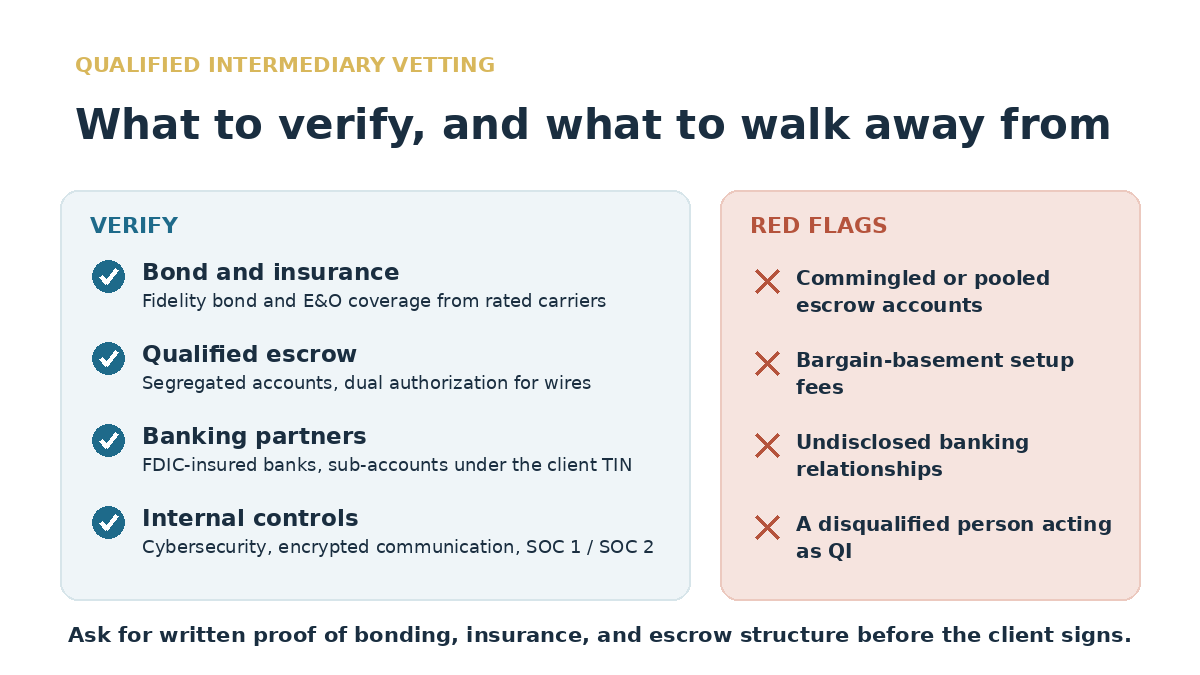
Begin your vetting process by evaluating the institutional backing and fund management practices of the accommodator. Request written proof of current fidelity bonding, corporate E&O policy declarations, and independent audit reports. Verify that the accommodator utilizes dual-authorization wire protocols, requiring both the investor's written consent and the QI manager's authorization before any funds leave escrow.
- Verify Bond and Insurance Limits: Ensure the QI maintains at least $10 million to $100 million in fidelity bonding and $10 million to $50 million in E&O coverage from rated insurance carriers.
- Confirm Qualified Escrow Usage: Mandate that client funds are held in segregated, interest-bearing accounts requiring dual authorization for all disbursements.
- Inspect Banking Partnerships: Verify that funds are deposited only with top-tier, FDIC-insured financial institutions using separate sub-accounts under the taxpayer's TIN.
- Evaluate Internal Controls: Review the company's cybersecurity protocols, encrypted communication systems, and SOC 1 / SOC 2 compliance certifications.
Experience, Industry Affiliations, and Track Record
Assess the accommodator's operational track record and professional standing within the real estate industry. Seek out qualified intermediaries affiliated with recognized professional bodies, such as the Federation of Exchange Accommodators (FEA), and professionals holding the Certified Exchange Specialist (CES®) designation. Experienced QIs have successfully managed complex reverse exchanges, improvement exchanges, and multi-asset portfolios, providing invaluable technical support when transaction complications arise.
Red Flags: What to Watch Out for When Evaluating a Qualified Intermediary
Identifying potential warning signs during the vetting process protects your client from disastrous financial loss and catastrophic tax liability. Because federal regulations do not mandate licensing for accommodators, realtors must remain vigilant against qualified intermediary mistakes and predatory business practices.
Co-Mingled Escrow Accounts and Unreasonably Low Fees
The most dangerous red flag in the exchange industry is the use of commingled or pooled escrow accounts. If an accommodator deposits multiple clients' funds into a single master account without individual sub-accounting, your client's capital is exposed to severe credit and insolvency risks if another transaction fails. Additionally, beware of providers offering bargain-basement setup fees. Low transaction fees often indicate that the provider relies on aggressive yield-spread capture on escrow interest or lacks adequate insurance coverage and security infrastructure.
Lack of Independent Banking Partners and Disqualified Person Conflicts
Another critical warning sign is an accommodator's failure to disclose their banking relationships or internal controls. Under IRS rules, certain individuals are legally classified as disqualified persons and cannot serve as a client's qualified intermediary. A disqualified person includes anyone who has acted as the client's employee, attorney, accountant, investment banker, or licensed real estate agent within the two-year period preceding the exchange closing date. Recommending a family member, personal accountant, or brokerage affiliate who qualifies as a disqualified person will immediately invalidate the exchange.
How the Qualified Intermediary Facilitates Your Client's Replacement Property Search
Finding suitable replacement property within the 45-day window is often the most stressful phase of a 1031 exchange for real estate investors. A proactive qualified intermediary actively supports the search process by providing clear structural parameters, verifying property eligibility, and ensuring compliance with IRS identification standards.
Proper Documentation of Identified Replacement Properties
During the 45-day identification period, your client must formally submit written identification to the qualified intermediary listing potential replacement properties. The identification notice must contain an unambiguous legal description or physical street address. The QI reviews the document to ensure strict compliance with one of three IRS identification rules:
- The 3-Property Rule: Identifying up to three properties of any aggregate fair market value.
- The 200% Rule: Identifying any number of properties, provided their total aggregate fair market value does not exceed 200% of the relinquished property's gross sales price.
- The 95% Rule: Identifying any number of properties, provided the investor acquires at least 95% of the total aggregate value of all identified properties.
Coordinating Replacement Closing Funds with Lenders and Settlement Agents
Once replacement properties are selected and under contract, the qualified intermediary coordinates closing mechanics directly with the buyer's lender, title company, and settlement attorney. The QI prepares the assignment of the purchase contract, issues closing instructions, and transfers exact exchange proceeds to the settlement table. Resources provided by x1031 Exchange help realtors align replacement property debt and equity requirements to avoid taxable mortgage boot.
Protecting Your Client: The Role of Due Diligence and Ongoing Communication
As a real estate agent, your role in a 1031 exchange extends beyond real property transactions to comprehensive advisory coordination. Ensuring smooth execution requires maintaining proactive communication between your client, their qualified intermediary, CPA, and closing attorney.
Pre-Listing QI Engagement Strategy
The most effective way to protect your client is establishing a pre-listing exchange protocol. Educate investment property sellers on exchange mechanics during your initial listing presentation. Engaging a vetted qualified intermediary before executing a purchase contract ensures that proper 1031 cooperation clauses are included in buyer negotiations and that exchange agreements are fully drafted prior to settlement.
Maintaining Communication Between Agent, QI, and Tax Adviser
Throughout the 180-day exchange window, maintain regular check-ins with the qualified intermediary and settlement team. Track key milestones, monitor replacement property inspection contingencies, and verify lender underwriting timelines. By fostering seamless professional collaboration, realtors safeguard client equity, minimize transaction stress, and position themselves as indispensable investment specialists.
Common Questions
Frequently Asked Questions
A qualified intermediary, also known as an exchange accommodator, is an independent third-party entity required by the IRS to facilitate a tax-deferred 1031 exchange. The intermediary enters into a written exchange agreement with the property owner, takes formal assignment of the relinquished and replacement sales contracts, and holds the net sales proceeds in a secure escrow account throughout the exchange period. By holding the proceeds, the qualified intermediary prevents the taxpayer from taking actual or constructive receipt of funds, which would immediately trigger capital gains tax liability. Real estate agents must understand the qualified intermediary's role to ensure their investor clients engage an accommodator before closing the sale. Failing to involve a qualified intermediary prior to closing permanently invalidates the tax deferral, creating severe tax liabilities for the client and significant legal exposure for the real estate brokerage.
For a real estate agent, assisting a client with a 1031 exchange follows a precise six-step operational sequence. First, identify the client's intent to exchange during pre-listing discovery and insert 1031 cooperation language into the sales contract. Second, ensure the client engages a vetted qualified intermediary prior to closing. Third, at relinquished property closing, settlement proceeds are wired directly to the intermediary's qualified escrow account. Fourth, guide your client through sourcing replacement properties during the strict 45-day identification period, ensuring formal written notice is delivered to the intermediary before midnight on day 45. Fifth, assist in negotiating purchase contracts for identified replacement properties and assign those contracts to the intermediary. Sixth, coordinate with the intermediary, lender, and title company to wire escrow funds and complete replacement property settlement within the 180-day window.
To maintain a valid 1031 exchange, a qualified intermediary must strictly enforce key Treasury regulations governed by Internal Revenue Code Section 1031. First, the intermediary must execute a binding exchange agreement and contract assignment prior to relinquished property transfer, ensuring the taxpayer avoids actual or constructive receipt of sale proceeds. Second, the intermediary must hold exchange funds in a qualified escrow or qualified trust account at an FDIC-insured financial institution. Third, the intermediary must enforce the statutory timelines, requiring written property identification by day 45 and complete transaction settlement by day 180. Fourth, the intermediary must ensure the replacement property is of like-kind real estate held for investment or business use. Finally, the intermediary must remain an independent party and cannot be a disqualified person who served as the client's agent, employee, or attorney within two years.
A qualified intermediary typically charges a flat setup and administrative fee ranging between $800 and $1,500 for a standard delayed 1031 exchange involving one relinquished property and one replacement property. Additional charges may apply if the client acquires multiple replacement properties, typically ranging from $200 to $400 per extra property, or requires complex structures like reverse or improvement exchanges, which can cost $3,000 to $8,000. Given that a successful 1031 exchange frequently defers tens or hundreds of thousands of dollars in capital gains taxes, depreciation recapture, and net investment income taxes, the intermediary's fee represents a tiny fraction of the total tax savings. Engaging an experienced, properly bonded qualified intermediary is essential to protecting your client's exchange validity and securing massive long-term wealth preservation.
The most frequent 1031 exchange mistake realtors make is allowing a transaction to close before engaging a qualified intermediary. If closing funds are wired to the seller's account, constructive receipt occurs and the exchange is legally destroyed. Another major mistake is failing to include 1031 exchange cooperation clauses in sales contracts, causing closing delays when buyers refuse assignment documentation. Realtors also frequently miscalculate the 45-day identification deadline or fail to ensure replacement property identification notices are delivered in writing directly to the intermediary. Additionally, agents often overlook debt replacement requirements, resulting in taxable mortgage boot when replacement financing falls short of relinquished debt payoff. Working with a knowledgeable qualified intermediary early in the listing process prevents these operational errors and keeps the transaction fully compliant.
Recommending a qualified intermediary during pre-listing consultation establishes proper transaction architecture well before critical deadlines begin. Early engagement allows the qualified intermediary to review proposed listing agreements, assist in drafting mandatory 1031 contract addendums, and structure the capital stack for replacement financing. It also gives your investor client ample time to complete institutional due diligence on the accommodator, verifying fidelity bonding, insurance coverage, and qualified escrow security. Furthermore, involving an accommodator early ensures that title companies and closing attorneys receive assignment paperwork well in advance of settlement, preventing last-minute closing delays. Proactively introducing a qualified intermediary reinforces your professional credibility as a sophisticated real estate advisor and ensures your client's exchange proceeds remain fully protected from day one.
If an unbonded or fraudulent qualified intermediary files for bankruptcy or misapproximates client funds, the consequences for property investors can be devastating. In bankruptcy proceedings, if exchange proceeds were held in commingled master accounts under the intermediary's corporate name, court trustees may treat client funds as general corporate assets rather than investor capital. This exposes the investor to total loss of cash proceeds and immediate capital gains tax liability due to failed replacement acquisition. To protect against bankruptcy and fund mishandling, realtors must ensure the accommodator utilizes qualified escrow or qualified trust accounts. These accounts hold funds under the client's individual taxpayer identification number, keeping equity legally segregated from the intermediary's liabilities and fully backed by fidelity bonding and performance guarantees.
Conclusion
Finding a trustworthy qualified intermediary is the single most critical decision determining your client's 1031 exchange success. As a real estate professional, conducting thorough institutional due diligence, verifying fidelity bonding and qualified escrow structures, and avoiding common industry red flags protects your client's hard-earned equity and ensures full compliance with IRS regulations. By proactively integrating a vetted qualified intermediary into your pre-listing workflow, you guide your clients through complex statutory timelines with confidence, safeguard their wealth, and solidify your reputation as an elite investment property specialist.
Work with X1031 Exchange
Explore comprehensive 1031 exchange guides, investor mortgage tools, and professional advisor resources at x1031.com. Connect with vetted qualified intermediary partners and access expert transaction tools to elevate your real estate practice today.
Talk to X1031 Exchange →Disclaimer
Educational information only. x1031 Exchange does not provide legal, tax, or lending advice. Real estate professionals and property owners should consult their qualified intermediary, CPA, tax attorney, and lender regarding specific transaction details.